
Advanced Flavor Retention: 4 Technologies for Premium Natural Extracts
Preserving the delicate 'soul' of botanical ingredients requires more than just raw material—it requires precision engineering. In this technical guide, we explore 4 advanced extraction methodologies, including Supercritical CO2, Low-Temperature Purge & Trap, and Controlled Freeze-Thaw. Discover how we overcome oxidation and thermal degradation to deliver natural extracts with authentic, full-bodied flavor profiles.
Author: Skylar – Premier Botanical Extract Manufacturer
Category: R&D / Extraction Technology
In the competitive landscape of botanical ingredients, "Natural" and "Fresh" are the ultimate benchmarks of quality. However, preserving the authentic aromatic profile of a plant is one of the industry's greatest challenges. Natural flavor compounds are often present in low concentrations, are insoluble in water, and are highly susceptible to oxidation and thermal decomposition.
As a dedicated plant extract supplier, we go beyond simple enrichment. We employ sophisticated processing techniques designed specifically to protect delicate volatile compounds from degradation. Below, we explore the four critical methods we utilize to ensure our extracts retain their natural soul.
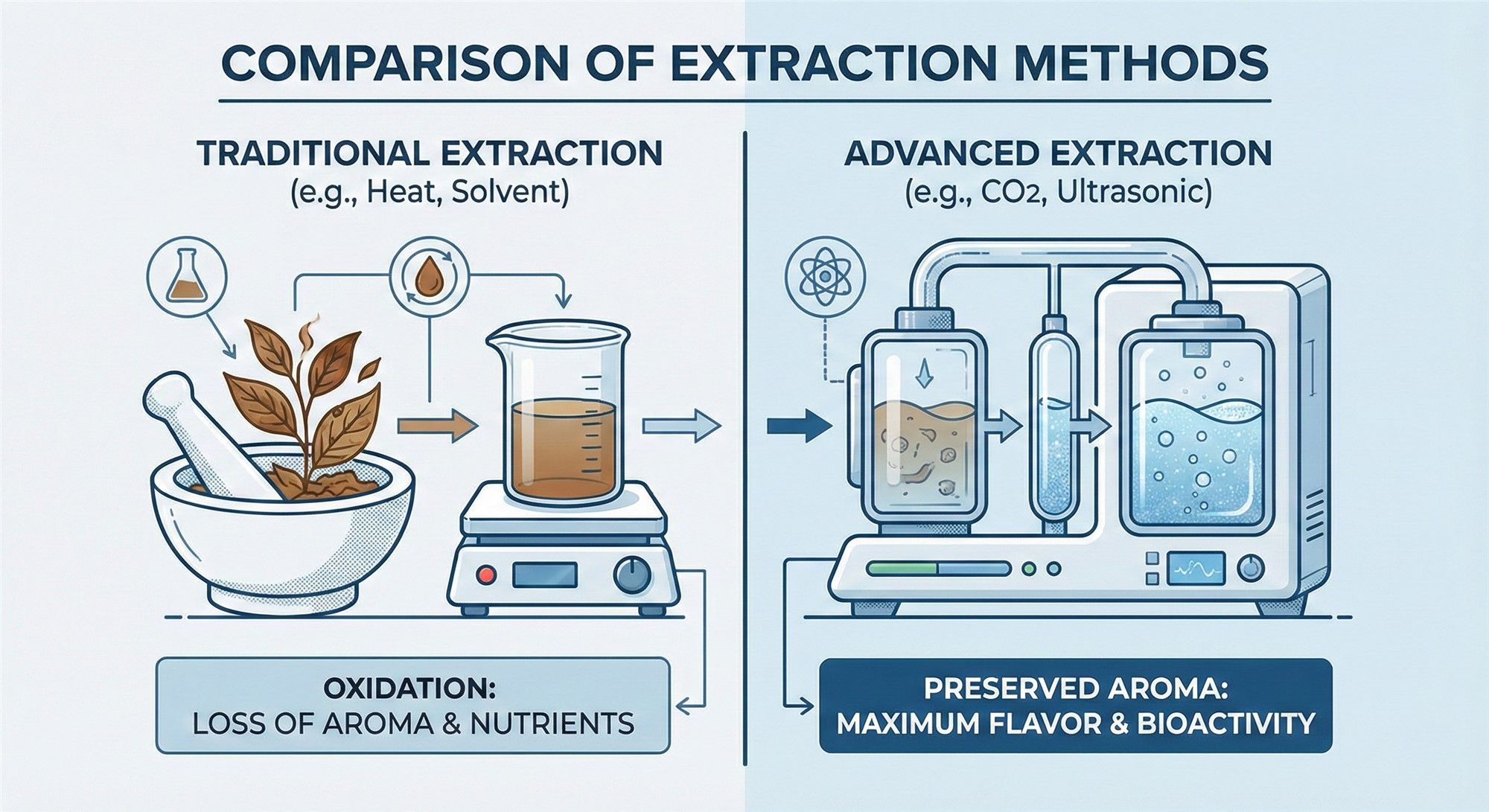
Comparison of traditional extraction vs advanced extraction methods
1. Low-Temperature Purge and Trap
Best for: Aroma Profiling and High-Value Micro-Extraction
This technique is the gold standard for capturing the most volatile, "top note" aromas that are usually lost in traditional processing.
The Principle: We use a flow of inert gas (typically high-purity nitrogen) to sweep volatile substances out of a liquid or solid sample. These volatiles are then trapped via low-temperature condensation or solid adsorption (using activated carbon or chromatographic materials).
Why It Works:
Oxidation Protection: The continuous nitrogen flow creates an oxygen-free environment.
Thermal Safety: The entire process operates at low temperatures, preserving heat-sensitive notes found in fresh flowers and fruits.
Purity: No organic solvents are introduced during the initial capture.
Supplier Insight: While excellent for preserving the truest flavor profile, this method is often limited by scale. We primarily utilize this for quality control profiling or ultra-premium, concentrated flavor fractions.
2. Controlled Freeze-Thaw Technology
Best for: Berry Extracts and Natural Fruit Juices
When dealing with fresh berries and fruits, mechanical processing can sometimes be too harsh. The "Freeze-Thaw" method leverages physics to extract flavor and nutrients naturally.
The Principle: Raw materials (like berries) are frozen rapidly (below -18℃) and then thawed at controlled low temperatures (4℃ to Room Temp).
Why It Works:
Cellular Disruption: Freezing causes intracellular water to form sharp ice crystals, mechanically rupturing cell walls. This releases more content and increases yield without thermal stress.
Enzymatic Control: The low temperature inhibits respiration and enzyme activity (like polyphenol oxidase), preventing browning and flavor degradation.
Supplier Insight: This method allows for fractional separation. By controlling the thawing time, we can collect the initial meltwater which is richer in flavor and sugar, separating it from the later, more watery fractions. This is ideal for e-liquid ingredients or concentrated beverage bases.
3. Solvent Extraction + Nitrogen Blowdown
Best for: Broad-Spectrum Flavor Extraction
Solvent extraction is an industry staple, but the removal of that solvent is where quality is defined. We utilize Nitrogen Blowdown to refine this classic approach.
The Principle: We use low-polarity organic solvents (e.g., Ethanol, Ethyl Acetate) to pull the full spectrum of flavor compounds. Instead of high-heat distillation, we use Nitrogen Blowdown—blowing nitrogen gas over the heated sample surface to evaporate the solvent.
Why It Works:
Rapid Evaporation: The gas flow increases the surface area for evaporation, removing solvents quickly.
Protective Blanket: The nitrogen displaces oxygen, preventing the extract from oxidizing as it concentrates.
Supplier Insight: This strikes a balance between scalability and quality. It allows us to produce larger batches while ensuring that the final product remains solvent-free and aromatically intact.
4. Supercritical CO2 Extraction (SFE)
Best for: Lipophilic Compounds, Essential Oils, and High-Purity Extracts
Supercritical Fluid Extraction is widely regarded as the cleanest and most effective technology for high-end botanical extraction.
The Principle: We utilize Carbon Dioxide (CO2) in its supercritical state (above 31.1℃ and 7.38 MPa). In this state, CO2 acts as a "hybrid" solvent—it has the density of a liquid to dissolve compounds but the diffusivity of a gas to penetrate plant material deep.
Why It Works:
Zero Residue: Once pressure is released, the CO2 evaporates completely, leaving a 100% pure extract with absolutely no solvent residue.
Low Thermal Impact: Operating at roughly 50℃ it is gentle enough for highly heat-sensitive flavors.
Tunability: We can adjust the polarity by adding "entrainers" (co-solvents like Ethanol) to target specific compounds.
Supplier Insight: Already a standard for coffee, tea, and spice extracts, our SFE capabilities allow us to deliver superior purity compared to traditional solvent methods.