Acetyl Octapeptide-3
Functions / Benefits
Quality Specifications
| Specification Item | Standard |
|---|---|
| Grade | Cosmetic Grade |
| Recommended Usage | 3%–5% (w/w) in finished formulation |
| Property 1 | 98% |
Description
Is Acetyl Octapeptide-3 (SNAP-8) More Effective Than Argireline for Wrinkle Reduction? Benefits, Mechanism & Comparison Guide Explained
Yes, Acetyl Octapeptide-3 (SNAP-8) is the next-generation botox-like peptide developed as an enhanced version of Argireline, with clinical data showing up to 63% reduction in wrinkle depth in 28 days — making it the most potent topical SNARE-inhibiting peptide currently available for expression line reduction.
What Is Acetyl Octapeptide-3?
Acetyl Octapeptide-3 (CAS 868844-74-0) is a synthetic neurotransmitter-inhibiting peptide composed of eight amino acids with an acetyl group at the N-terminus. It is commercially known as SNAP-8, developed by Lipotec (now part of Lubrizol) as a direct evolution of Argireline (Acetyl Hexapeptide-8). Its molecular formula is C₄₁H₇N₁₅O₁₂S with a molecular weight of approximately 1075.27 g/mol.
Like Argireline, Acetyl Octapeptide-3 is classified as a neurotransmitter-inhibiting peptide — a botox-like cosmetic active that mimics the mechanism of botulinum toxin without its toxicity or the need for injection. Its sequence is an extended version of the N-terminus of SNAP-25, the key SNARE complex protein responsible for docking acetylcholine-releasing vesicles at neuromuscular junctions. The two additional amino acids in SNAP-8’s octapeptide chain provide a longer, more complete SNAP-25-mimicking sequence, enabling stronger and more stable competition with SNAP-25 for binding to VAMP (vesicle-associated membrane protein). This results in more effective destabilization of the SNARE complex, greater inhibition of neuronal exocytosis, and a more pronounced reduction in facial muscle contractions and dynamic expression wrinkles.
Acetyl Octapeptide-3 is available as a white powder with ≥95% purity (HPLC), water-soluble, and stable across a pH range of 4.0–7.5. Like Argireline, it is best delivered in O/W emulsions or W/O/W multiple emulsions for optimal skin penetration.
Key Benefits of Acetyl Octapeptide-3
Enhanced SNARE Complex Inhibition: More Potent Than Argireline. The core mechanism of Acetyl Octapeptide-3 is the same as Argireline — competitive inhibition of the SNARE complex by mimicking the N-terminus of SNAP-25 — but with significantly greater potency due to its longer eight-amino-acid chain. The extended sequence provides a more complete structural mimic of SNAP-25, enabling stronger binding to VAMP and more effective disruption of the three-component SNARE complex (SNAP-25, VAMP, and syntaxin). This translates directly into greater inhibition of acetylcholine release, stronger reduction in facial muscle contraction frequency and intensity, and more pronounced smoothing of dynamic expression wrinkles.
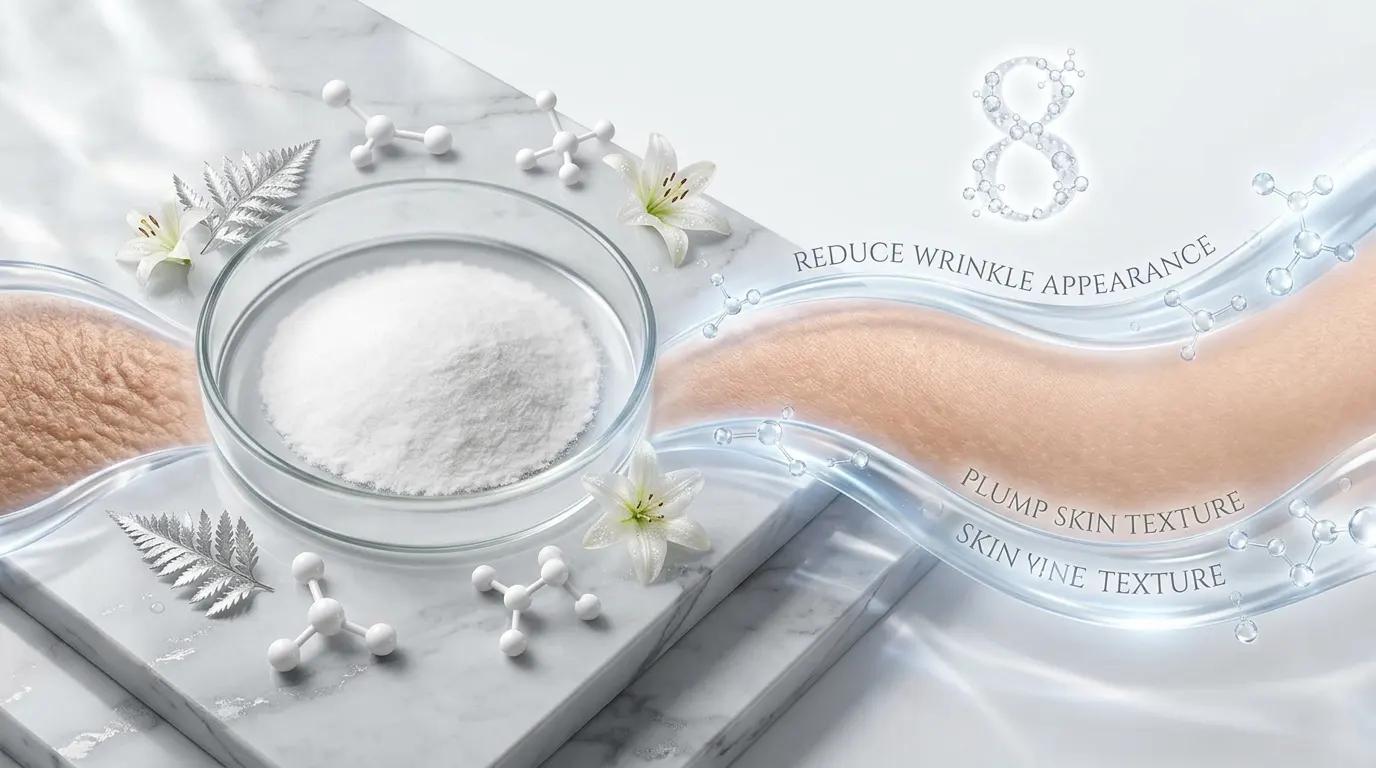
Clinically Proven: Up to 63% Wrinkle Reduction in 28 Days. Lipotec clinical data for SNAP-8 demonstrate up to 63% reduction in wrinkle depth after 28 days of twice-daily application — compared to up to 30–49% for Argireline over the same period. This represents a meaningful clinical differentiation, particularly for moderate to deep expression lines where Argireline’s efficacy may plateau. SNAP-8 is effective on forehead lines, crow’s feet, frown lines (glabellar lines), smile lines, and perioral lines.
Broader Wrinkle Coverage: Prevention and Treatment. While Argireline is best suited for fine lines and prevention, Acetyl Octapeptide-3 is effective for both prevention of new expression lines and treatment of existing moderate to deep wrinkles. Its stronger SNARE inhibition makes it the preferred choice for mature skin with established expression lines, and for formulations targeting visible, measurable wrinkle reduction rather than maintenance alone.
Synergistic with Argireline. Acetyl Octapeptide-3 and Argireline can be combined in the same formulation for additive SNARE inhibition — covering both the initial competitive binding (Argireline’s faster onset) and the deeper, more sustained inhibition (SNAP-8’s greater potency). Many premium anti-wrinkle formulations combine both peptides at their respective optimal concentrations for maximum expression line coverage.
Excellent Tolerability. Like Argireline, Acetyl Octapeptide-3 is non-toxic, non-irritating, and suitable for all skin types including sensitive skin. It does not carry the systemic toxicity risks of botulinum toxin and does not require medical supervision for topical application.
Acetyl Octapeptide-3 (SNAP-8) vs. Acetyl Hexapeptide-8 (Argireline): Which Is Better?
Acetyl Octapeptide-3 (SNAP-8) and Acetyl Hexapeptide-8 (Argireline) are the two leading botox-like peptides in prestige skincare, both developed by Lipotec and both targeting the SNARE complex. They share the same fundamental mechanism but differ in chain length, potency, clinical efficacy, and ideal use case.
Acetyl Octapeptide-3 (SNAP-8, CAS 868844-74-0) is an octapeptide (8 amino acids + acetyl), an extended SNAP-25 N-terminus mimic with stronger VAMP binding, provides stronger and more sustained SNARE complex inhibition, clinically shown to reduce wrinkle depth by up to 63% in 28 days, is used at 3%–5% w/w (effective at lower concentration than Argireline), may take slightly longer for initial results but delivers stronger long-term effects, and is best suited for moderate to deep expression lines, mature skin, and formulations targeting measurable wrinkle reduction. It is the most potent topical botox-like peptide available.
Acetyl Hexapeptide-8 (Argireline, CAS 616204-22-9) is a hexapeptide (6 amino acids + acetyl), the original SNAP-25 N-terminus mimic, provides effective SNARE complex inhibition with faster initial onset, clinically shown to reduce wrinkle depth by up to 30–49% in 4 weeks, is used at 5%–10% w/w, shows results in 1–2 weeks, and is best suited for fine to moderate expression lines, prevention, and sensitive skin. It is the gold standard botox-like peptide with the longest clinical track record.
Bottom line: SNAP-8 is the more potent peptide for deeper wrinkles and mature skin; Argireline offers faster initial results and a longer evidence base for fine lines and prevention. For maximum expression line reduction, combining both peptides in the same formulation is the most effective strategy — and further combining them with collagen-stimulating peptides (Matrixyl, Matrixyl 3000, SYN-COLL, Hexapeptide-9) addresses both dynamic wrinkles and structural collagen loss for comprehensive anti-aging coverage.
Formulation and Usage Recommendations
Acetyl Octapeptide-3 is used at 3%–5% w/w in finished formulations — a lower concentration than Argireline, reflecting its greater potency per unit weight. It is water-soluble and should be added to the aqueous phase during formulation at temperatures below 40°C. Optimal pH range is 4.0–7.5. As with Argireline, penetration is significantly enhanced by O/W emulsions and W/O/W multiple emulsions; W/O emulsions are not recommended.
It combines synergistically with Acetyl Hexapeptide-8 / Argireline (for combined fast-onset + sustained SNARE inhibition), Palmitoyl Pentapeptide-4 / Matrixyl (for collagen stimulation to address structural wrinkles alongside expression lines), Palmitoyl Tripeptide-1 + Palmitoyl Tetrapeptide-7 / Matrixyl 3000 (for comprehensive collagen + anti-inflammatory coverage), Palmitoyl Tripeptide-5 / SYN-COLL (for TGF-β-mediated collagen stimulation and MMP inhibition), and Hexapeptide-9 / Collaxyl (for DEJ regeneration and skin density improvement).
Typical finished product applications include high-performance anti-wrinkle serums, eye creams, forehead creams, expression line treatments, and multi-peptide complex formulations targeting both dynamic and structural aging in mature skin.
Safety and Precautions
Acetyl Octapeptide-3 has an excellent safety profile and is approved for use in cosmetic formulations globally, including under EU Cosmetics Regulation and FDA cosmetic guidelines. It is non-toxic, non-mutagenic, and non-sensitizing at recommended use levels. Unlike botulinum toxin, it does not carry systemic toxicity risks and does not require medical supervision for topical application. No significant adverse reactions have been reported in clinical studies at standard cosmetic use concentrations.
This ingredient is intended for use in topical cosmetic formulations only and is not for oral consumption or injection. Formulators should conduct standard patch testing and stability assessments for finished products. Always consult with a qualified cosmetic chemist or dermatologist before incorporating new actives into clinical or consumer formulations. These statements have not been evaluated by the Food and Drug Administration. This product is not intended to diagnose, treat, cure, or prevent any disease.