
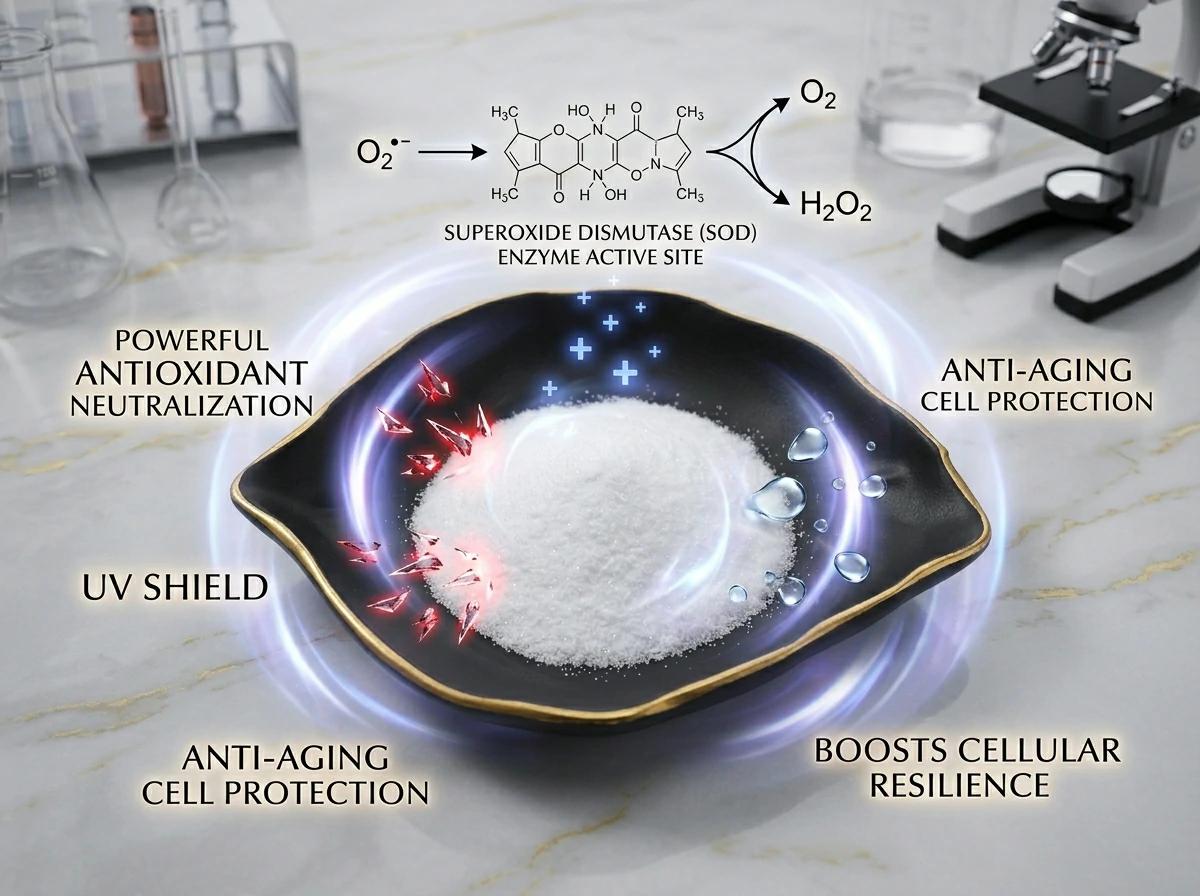
Superoxide Dismutase
Functions / Benefits
Quality Specifications
| Specification Item | Standard |
|---|---|
| Grade | Cosmetic Grade |
| Recommended Usage | 0.1–1% (topical); 100–2000 IU/day (oral supplement) |
| Property 1 | 2000IU/mg |
| Property 2 | 10000IU/mg |
Description
Is Superoxide Dismutase (SOD) Effective for Anti-aging and Skin Protection? Benefits, Uses & Science Explained
Yes, Superoxide Dismutase (SOD) is one of the most powerful antioxidant enzymes in the human body, clinically recognized for its ability to neutralize superoxide radicals — the primary driver of oxidative stress, cellular aging, and inflammation.
What Is Superoxide Dismutase?
Superoxide Dismutase (SOD) is a metalloenzyme that catalyzes the dismutation of superoxide radicals (O₂⁻) into molecular oxygen (O₂) and hydrogen peroxide (H₂O₂), which is then further neutralized by catalase and glutathione peroxidase. It is the body’s first line of enzymatic defense against oxidative damage.
Three primary isoforms exist in humans:
- SOD1 (Cu/Zn-SOD): Found in the cytoplasm; the most abundant form.
- SOD2 (Mn-SOD): Located in the mitochondria; critical for cellular energy protection.
- SOD3 (EC-SOD): Extracellular form; protects tissues and blood vessels.
CAS Number: 9054-89-1
EC Number: 1.15.1.1
INCI Name: Superoxide Dismutase
Molecular Weight: ~32,000 Da (Cu/Zn-SOD dimer)
Appearance: White to off-white lyophilized powder
Activity: ≥1,000 IU/mg (up to 10,000 IU/mg available)
Solubility: Freely soluble in water
Key Benefits of Superoxide Dismutase
- Free Radical Scavenging: Directly dismutates superoxide radicals — the most reactive and damaging ROS species — at rates near the diffusion limit.
- Anti-aging: Reduces oxidative damage to DNA, proteins, and lipids, slowing cellular senescence and visible skin aging.
- Skin Brightening & Repair: Decreases UV-induced oxidative stress, supporting skin barrier recovery and reducing hyperpigmentation.
- Anti-inflammatory: Suppresses NF-κB signaling and pro-inflammatory cytokine production driven by superoxide.
- UV & Environmental Protection: Shields skin cells from photooxidative damage caused by UV radiation and pollution.
- Mitochondrial Protection: SOD2 preserves mitochondrial integrity, supporting cellular energy metabolism and longevity.
Superoxide Dismutase vs. Glutathione: Which Antioxidant Is More Powerful?
Both SOD and Glutathione are cornerstone antioxidants, but they operate at different stages of the oxidative stress cascade and serve distinct biological roles.
Verdict: SOD and Glutathione are highly complementary. SOD neutralizes the initial superoxide burst, while Glutathione handles downstream peroxides and toxins. Combining both — alongside Vitamin C and Catalase — creates a comprehensive, multi-layered antioxidant defense system ideal for premium anti-aging and skin-brightening formulations.
Applications
Cosmetic & Skincare:
Used in anti-aging serums, sunscreens, post-procedure recovery creams, and brightening masks. Encapsulated or liposomal forms are recommended for enhanced skin penetration and stability. Typical topical usage rate: 0.1–1%.
Nutraceuticals & Supplements:
Available in enteric-coated capsules, liposomal formulations, and gliadin-bound forms (GliSODin®) for improved oral bioavailability. Common dosage: 100–2000 U/day.
Pharmaceutical & Research:
Investigated for applications in inflammatory diseases, ischemia-reperfusion injury, neurodegenerative conditions, and cancer adjunct therapy.
Recommended Usage
- Topical: 0.1–1% in finished formulations; use encapsulated or liposomal SOD for optimal stability and penetration. Combine with Vitamin C and Glutathione for synergistic antioxidant effect.
- Oral Supplement: 100–500 U/day for general antioxidant support; gliadin-bound forms (GliSODin®) are preferred for oral delivery due to significantly improved bioavailability.
- Storage: Store at 2–8°C, away from light and moisture. Avoid repeated freeze-thaw cycles to preserve enzyme activity.
Medical Disclaimer: The information provided here is for educational and informational purposes only and is not intended as medical advice. Always consult with a qualified healthcare provider or licensed physician before starting any new supplement regimen, particularly if you are pregnant, nursing, have a pre-existing medical condition, or are taking prescription medications. Enzyme activity and efficacy may vary depending on formulation, delivery method, and individual physiology. Individual results may vary.