
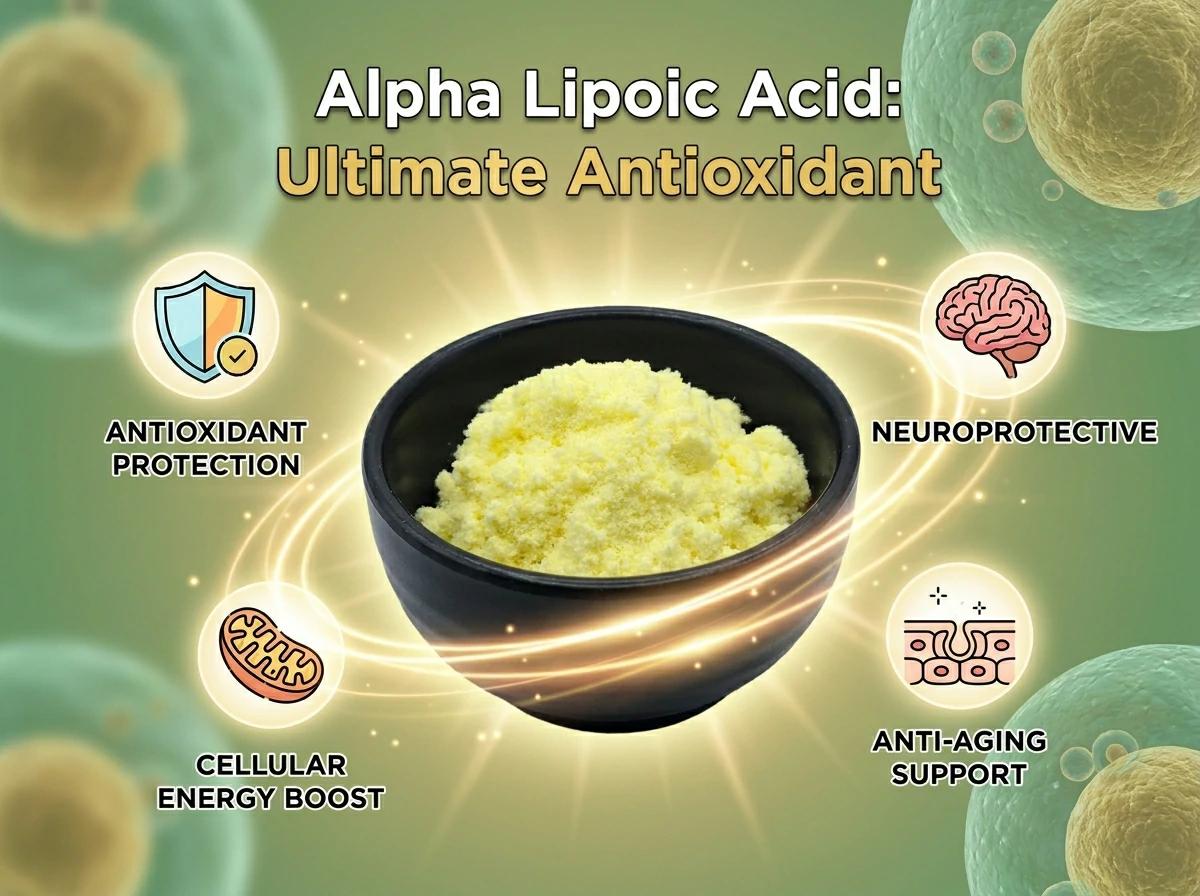
Alpha Lipoic Acid
Functions / Benefits
Quality Specifications
| Specification Item | Standard |
|---|---|
| Grade | Pharmaceutical Grade |
| Recommended Usage | 0.5–5% (topical); 100–600 mg/day (oral supplement) |
| Property 1 | 98% |
| Property 2 | 99% |
Description
Is Alpha Lipoic Acid Good for Skin and Health? Benefits, Dosage & Side Effects Explained
Yes, Alpha Lipoic Acid (ALA) is a uniquely versatile antioxidant that works in both water- and fat-soluble environments, making it one of the most comprehensive anti-aging and metabolic support ingredients available in cosmetic and nutraceutical formulations.
What Is Alpha Lipoic Acid?
Alpha Lipoic Acid (ALA), also known as Thioctic Acid, is a naturally occurring organosulfur compound synthesized in small amounts by the human body and found in mitochondria as an essential cofactor for energy metabolism. Unlike most antioxidants, ALA is both water- and fat-soluble, allowing it to function across all cellular compartments — a property that makes it exceptionally effective as a universal antioxidant.
ALA exists in two forms:
- R-ALA (R-Alpha Lipoic Acid): The biologically active, naturally occurring enantiomer; more potent and bioavailable.
- S-ALA: The synthetic mirror image; less active but present in racemic (R/S) mixtures.
CAS Number: 1077-28-7
INCI Name: Thioctic Acid
Molecular Formula: C₈H₁₄O₂S₂
Molecular Weight: 206.33 g/mol
Appearance: Yellow crystalline powder
Solubility: Slightly soluble in water; soluble in ethanol, oils, and organic solvents
Melting Point: 47–48°C
Key Benefits of Alpha Lipoic Acid
- Universal Antioxidant: Active in both aqueous and lipid environments — uniquely capable of protecting cell membranes and cytoplasm simultaneously.
- Antioxidant Recycling: Regenerates and extends the activity of Vitamins C and E, Glutathione, and CoQ10 — amplifying the entire antioxidant network.
- Anti-aging & Skin Brightening: Inhibits glycation (sugar-protein cross-linking that stiffens skin), reduces fine lines, and promotes a more even skin tone.
- Pore Minimizing: Exerts mild exfoliating action, helping to refine skin texture and reduce the appearance of enlarged pores.
- Anti-inflammatory: Inhibits NF-κB activation, reducing inflammatory cytokine production and redness.
- Blood Sugar & Metabolic Support: Enhances insulin sensitivity and glucose uptake in cells; widely studied for diabetic neuropathy management.
- Neuroprotection: Crosses the blood-brain barrier; protects neurons from oxidative damage and supports cognitive health.
- Mitochondrial Support: Acts as a cofactor in the pyruvate dehydrogenase and alpha-ketoglutarate dehydrogenase complexes, supporting cellular energy production.
Alpha Lipoic Acid vs. Vitamin C vs. Glutathione: Which Is the Best Antioxidant?
ALA, Vitamin C, and Glutathione are three of the most studied antioxidants in cosmetic and nutraceutical science. Each has distinct strengths — and they work best together.
Feature
Alpha Lipoic Acid (ALA)
Vitamin C (Ascorbic Acid)
Glutathione (GSH)
Solubility
Both water & fat-soluble ✅
Water-soluble only
Water-soluble only
Antioxidant Recycling
Recycles Vit C, Vit E, GSH, CoQ10
Recycles Vit E
Recycles Vit C, Vit E
Skin Brightening
✅ Moderate (anti-glycation)
✅ Strong (tyrosinase inhibition)
✅ Strong (tyrosinase inhibition)
Anti-aging
✅ Strong (anti-glycation, pore refining)
✅ Strong (collagen synthesis)
✅ Strong (oxidative stress reduction)
Anti-inflammatory
✅ Strong (NF-κB inhibition)
✅ Moderate
✅ Moderate
Blood Sugar Support
✅ Strong (insulin sensitization)
❌ Limited
❌ Limited
Neuroprotection
✅ Strong (crosses BBB)
✅ Moderate
✅ Moderate
Oral Bioavailability
Moderate (R-ALA preferred)
High
Moderate (liposomal preferred)
Topical Stability
Moderate (light/heat sensitive)
Low (highly unstable)
Moderate (oxidation-sensitive)
Best Combined With
Vit C, Glutathione, CoQ10
ALA, Glutathione
ALA, Vit C, SOD
Verdict: ALA’s dual solubility and antioxidant-recycling capability make it the most versatile of the three. While Vitamin C excels at collagen synthesis and Glutathione at detoxification and skin brightening, ALA uniquely bridges both worlds — and amplifies the effectiveness of all other antioxidants in the formulation. For maximum anti-aging and brightening results, combining all three is the gold standard approach.
Applications
Cosmetic & Skincare:
Used in anti-aging serums, brightening creams, eye contour treatments, and exfoliating formulations. Encapsulated or stabilized forms are recommended to prevent oxidation. Typical topical usage rate: 0.5–5%.
Nutraceuticals & Supplements:
Available in capsules, tablets, and sustained-release formulations. R-ALA forms offer superior bioavailability over racemic (R/S) mixtures. Common oral dosage: 100–600 mg/day.
Pharmaceutical:
Approved in several countries for the treatment of diabetic peripheral neuropathy (IV and oral). Investigated for applications in metabolic syndrome, liver disease, and neurodegenerative conditions.
Recommended Usage
- Topical: 0.5–5% in finished formulations; use stabilized or encapsulated ALA to minimize oxidation. Combine with Vitamin C and Glutathione for a synergistic brightening and anti-aging effect. Avoid high-temperature processing.
- Oral Supplement: 100–300 mg/day of racemic ALA, or 50–150 mg/day of R-ALA, for general antioxidant and metabolic support. Take on an empty stomach for optimal absorption. Doses up to 600 mg/day are used under medical supervision for neuropathy.
- Storage: Store in a cool, dry place away from light and heat. Keep tightly sealed to prevent oxidation. Recommended storage temperature: below 25°C.
Medical Disclaimer: The information provided here is for educational and informational purposes only and is not intended as medical advice. Always consult with a qualified healthcare provider or licensed physician before starting any new supplement regimen, especially if you are pregnant, nursing, managing diabetes or blood sugar conditions, or taking prescription medications. ALA may interact with certain medications including insulin and chemotherapy agents. Individual results may vary.