
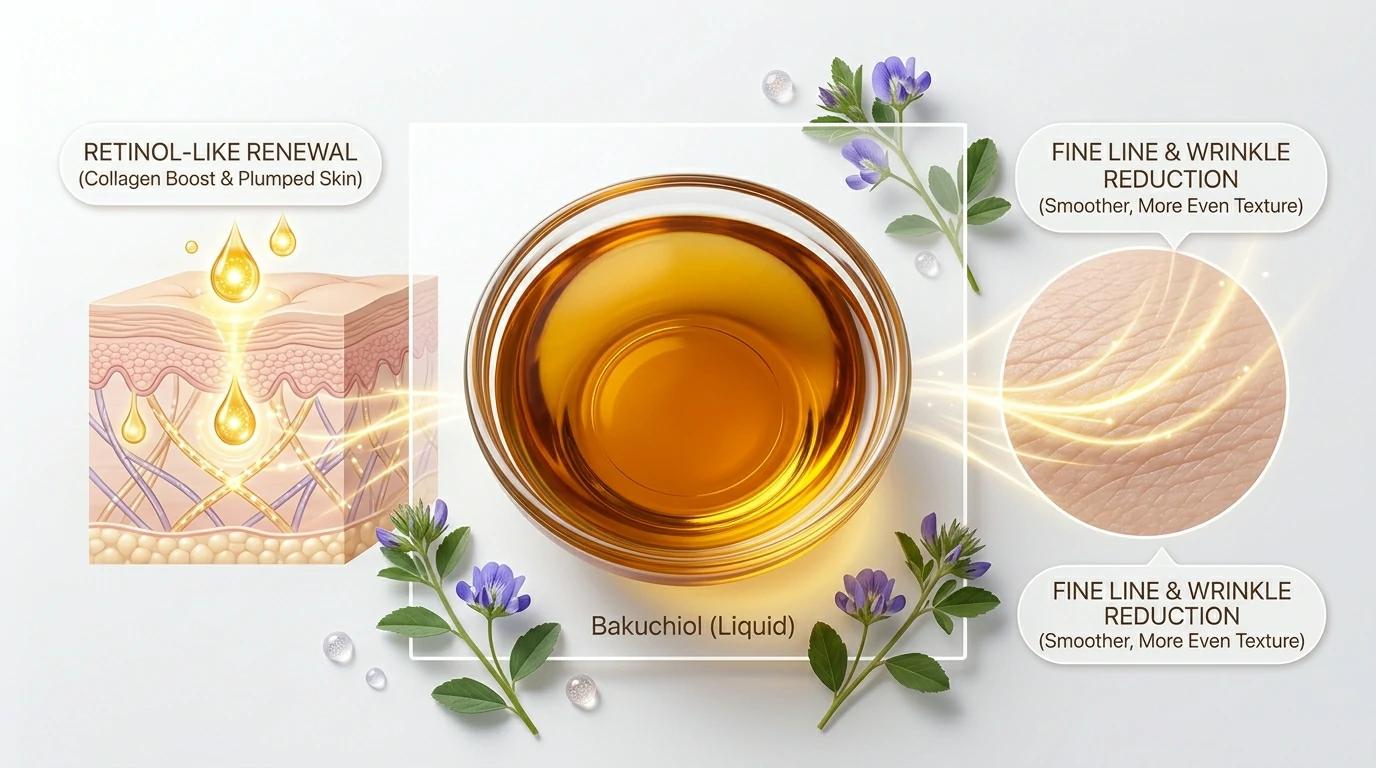
Bakuchiol (Liquid)
Functions / Benefits
Quality Specifications
| Specification Item | Standard |
|---|---|
| Grade | Cosmetic Grade |
| Recommended Usage | 0.5–2% (topical) |
| Property 1 | 95% |
| Property 2 | 98% |
| Property 3 | 99% |
Description
Is Bakuchiol a Good Alternative to Retinol? Anti-aging Benefits, Safety & Science Explained
Yes, Bakuchiol is the most clinically validated natural alternative to retinol, delivering comparable anti-aging, collagen-stimulating, and skin-brightening results without retinol’s characteristic irritation, photosensitivity, or pregnancy safety concerns — making it the gold-standard retinol substitute for sensitive skin and clean beauty formulations.
What Is Bakuchiol?
Bakuchiol is a meroterpene phenol naturally extracted from the seeds and leaves of Psoralea corylifolia (Babchi plant), a herb used for centuries in Ayurvedic and Traditional Chinese Medicine for skin disorders, vitiligo, and anti-aging. It is supplied as a pale yellow to amber liquid with a characteristic mild herbal scent.
Despite having no structural similarity to retinol, Bakuchiol functionally mimics retinol’s mechanism of action by upregulating the same retinoid-responsive genes (RARα, RARβ, RARγ) and stimulating collagen synthesis, cell turnover, and MMP inhibition — without binding to retinoic acid receptors or triggering the retinoid irritation cascade.
A landmark double-blind clinical study published in the British Journal of Dermatology (2019) demonstrated that 0.5% Bakuchiol applied twice daily was equivalent to 0.5% retinol in reducing wrinkles, hyperpigmentation, and skin roughness, with significantly less facial scaling and stinging.
CAS Number: 10309-37-2
INCI Name: Bakuchiol
Latin Name: Psoralea corylifolia L.
Molecular Formula: C₁₈H₂₄O
Molecular Weight: 256.38 g/mol
Appearance: Pale yellow to amber liquid
Solubility: Soluble in oils, ethanol, and most cosmetic emollients; insoluble in water
Available Specs: 95%, 98%, 99% purity
Key Benefits of Bakuchiol
- Retinol-equivalent Anti-aging: Clinically proven to reduce fine lines, wrinkles, and skin roughness to the same degree as 0.5% retinol, with significantly better tolerability.
- Collagen Synthesis: Upregulates Type I, III, and IV collagen gene expression via retinoid-responsive pathways, improving skin firmness and density.
- Skin Brightening: Inhibits tyrosinase activity and reduces UV-induced melanin overproduction, supporting a more even and luminous complexion.
- Antioxidant: Scavenges free radicals and reduces oxidative stress-driven skin aging, complementing its retinol-mimetic activity.
- Anti-inflammatory: Inhibits NF-κB and COX-2 pathways, reducing skin redness and inflammation — unlike retinol, which can trigger inflammatory responses.
- Wrinkle Reduction & Pore Minimizing: Promotes cell turnover and collagen remodeling, reducing the appearance of fine lines and enlarged pores.
- Pregnancy-safe: Unlike retinol and retinoids, Bakuchiol is not a vitamin A derivative and does not carry teratogenic risk, making it suitable for use during pregnancy and breastfeeding (consult healthcare provider).
- Photostable: Stable under UV exposure — can be used in both AM and PM formulations, unlike retinol which degrades in sunlight and increases photosensitivity.
- Sensitive Skin Compatible: Clinically demonstrated to cause significantly less irritation, scaling, and stinging than retinol, making it ideal for sensitive, rosacea-prone, and reactive skin types.
Bakuchiol vs. Retinol vs. Retinal: Which Is the Best Anti-aging Vitamin A Alternative?
Bakuchiol, Retinol, and Retinal (Retinaldehyde) are three of the most widely used anti-aging actives in modern skincare. Understanding their differences is essential for choosing the right ingredient for your formulation or skin type.
Verdict: Bakuchiol is the clear winner for sensitive skin, pregnancy-safe formulations, and clean beauty positioning — delivering retinol-equivalent results with dramatically better tolerability and photostability. Retinol remains the gold standard for proven anti-aging efficacy with decades of clinical data. Retinal offers the fastest and most potent results but requires careful formulation and is unsuitable for sensitive skin. For a comprehensive anti-aging system, Bakuchiol can be combined with Retinol at lower concentrations to enhance efficacy while minimizing irritation.
Applications
Cosmetic & Skincare:
Used in anti-aging serums, face oils, moisturizers, eye creams, and brightening treatments. Bakuchiol is oil-soluble and works best in anhydrous, oil-in-water emulsion, or serum formulations. As a liquid, it is easy to incorporate directly into oil phases. Typical topical usage rate: 0.5–2%. Suitable for both AM and PM use — a key formulation advantage over retinol.
Clean Beauty & Natural Formulations:
Bakuchiol is the preferred retinol alternative in natural, organic, vegan, and clean beauty product lines. It is plant-derived, biodegradable, and free from the regulatory restrictions that apply to retinoids in some markets (e.g., EU restrictions on retinol in body lotions).
Recommended Usage
- Topical: 0.5–2% in oil-based serums, face oils, or oil-in-water emulsions. Incorporate into the oil phase during formulation. Bakuchiol is compatible with most cosmetic actives including Vitamin C, Niacinamide, AHAs, and Peptides — unlike retinol, which requires careful pH and ingredient compatibility management. Can be used morning and evening without photosensitivity concerns.
- Beginner Tip: Start at 0.5% for sensitive skin types and increase to 1–2% as tolerated. Unlike retinol, Bakuchiol does not typically require a gradual introduction period, but patch testing is always recommended.
- Storage: Store in a cool, dark place away from light and heat. Recommended storage temperature: 5–25°C. Keep tightly sealed to prevent oxidation. Bakuchiol liquid is more stable than retinol under standard storage conditions but should still be protected from prolonged UV exposure.
Medical Disclaimer: The information provided here is for educational and informational purposes only and is not intended as medical advice. Always consult with a qualified healthcare provider or licensed physician before using Bakuchiol during pregnancy or breastfeeding, or if you have a known allergy to plants in the Fabaceae family. While Bakuchiol is generally considered safe for sensitive skin, individual reactions may vary. Patch testing is recommended before full application. Individual results may vary.