Carnosic Acid
Functions / Benefits
Quality Specifications
| Specification Item | Standard |
|---|---|
| Grade | Cosmetic Grade |
| Recommended Usage | 0.01%–0.5% (topical formulations) |
| Property 1 | 90% |
| Property 2 | 95% |
| Property 3 | 98% |
Description
Is Carnosic Acid the Most Powerful Natural Antioxidant for Skin and Food? Benefits, Dosage & Science Explained
Yes, Carnosic Acid is one of the most potent naturally occurring lipophilic antioxidants known to science — a phenolic diterpene from rosemary and sage with exceptional free radical scavenging capacity, making it a premier ingredient for both cosmetic anti-aging formulations and food preservation applications.
What Is Carnosic Acid?
Carnosic Acid is a bioactive phenolic diterpene isolated from the leaves of Salvia rosmarinus (Rosemary) and Salvia officinalis (Sage), two of the most antioxidant-rich culinary herbs in the world. It is the primary antioxidant compound responsible for rosemary extract’s exceptional oxidative stability and biological activity.
Carnosic Acid is a lipid-soluble (fat-soluble) antioxidant, making it particularly effective at protecting cell membranes, lipid-rich formulations, and fatty food matrices from oxidative degradation — a key advantage over water-soluble antioxidants like Vitamin C.
It is also the precursor to Carnosol, another potent rosemary antioxidant formed by the oxidation of Carnosic Acid. Together, Carnosic Acid and Carnosol account for approximately 90% of the antioxidant activity of rosemary extract.
CAS Number: 3650-09-7
INCI Name: Rosmarinus Officinalis (Rosemary) Leaf Extract
Latin Name: Salvia rosmarinus Schleid.
Molecular Formula: C₂₀H₂₈O₄
Molecular Weight: 332.43 g/mol
Appearance: White to off-white crystalline powder
Solubility: Lipid-soluble; soluble in ethanol, acetone, and oils; poorly soluble in water
Available Specs: 90%, 95%, 98% purity
Key Benefits of Carnosic Acid
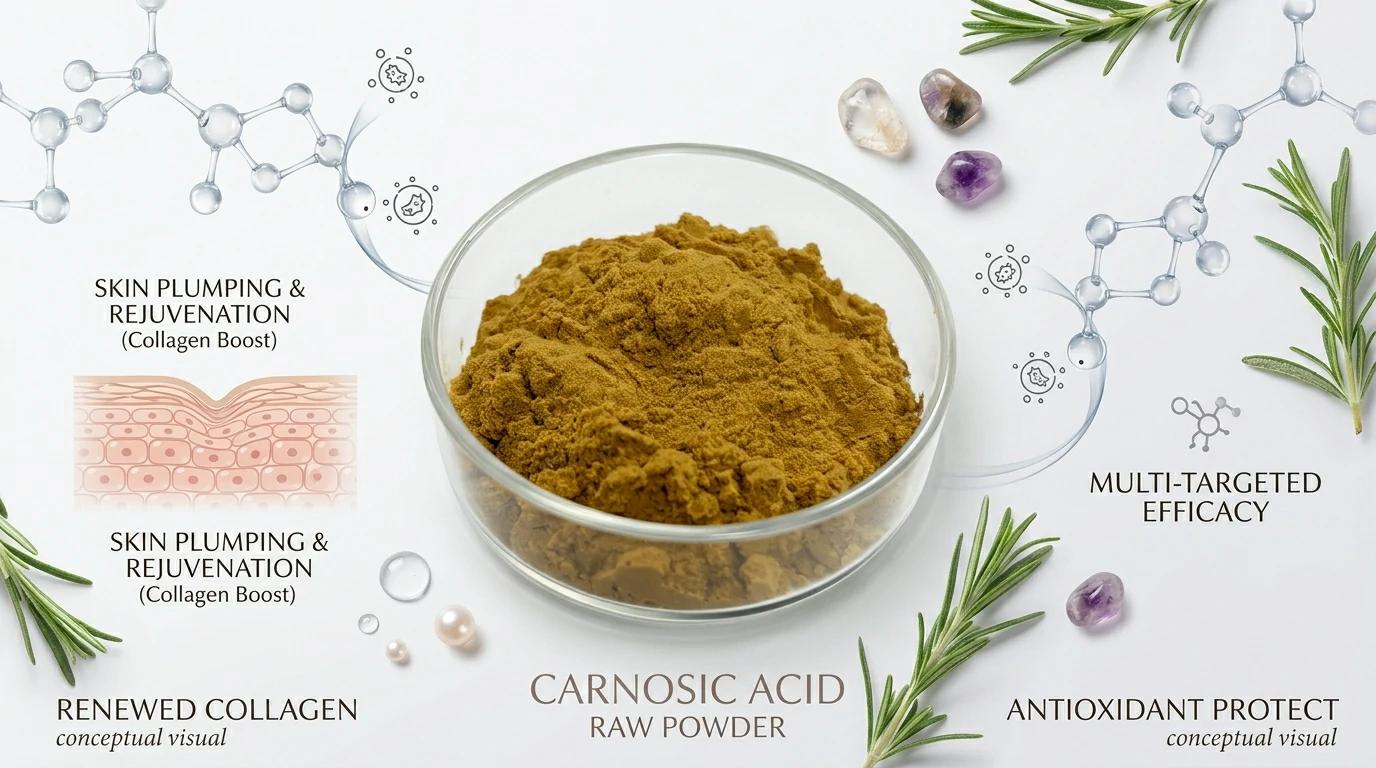
- Exceptional Antioxidant Activity: One of the most potent natural lipophilic antioxidants, with an ORAC value significantly higher than Vitamin E (tocopherol). Scavenges peroxyl radicals, hydroxyl radicals, and singlet oxygen, protecting lipids and cell membranes from oxidative damage.
- Skin Anti-aging: Inhibits MMP-1 (collagenase) and MMP-3 (stromelysin), protecting collagen and elastin from enzymatic degradation. Reduces UV-induced oxidative stress and supports skin barrier integrity.
- Neuroprotection: Activates the Nrf2/ARE pathway, upregulating endogenous antioxidant enzymes (SOD, catalase, glutathione peroxidase). Studied for applications in Alzheimer’s disease, Parkinson’s disease, and ischemic brain injury.
- Anti-inflammatory: Inhibits NF-κB activation and COX-2 expression, reducing pro-inflammatory cytokine production. Particularly effective against neuroinflammation and skin inflammation.
- Antimicrobial: Demonstrates broad-spectrum antimicrobial activity against gram-positive bacteria (Staphylococcus aureus, Bacillus cereus) and certain fungi, relevant for both cosmetic preservation and food safety.
- Food Preservation: Approved as a natural food antioxidant (E392 in EU) for use in fats, oils, and fat-containing foods. Prevents lipid peroxidation and rancidity, extending shelf life without synthetic preservatives.
- Hair Care: Activates IGF-1 signaling in dermal papilla cells, promoting hair follicle proliferation and potentially supporting hair growth. Used in premium hair care formulations.
- Anti-cancer Research: Studied for pro-apoptotic and anti-proliferative effects in multiple cancer cell lines via Nrf2 and NF-κB pathway modulation.
Carnosic Acid vs. Carnosol vs. Rosmarinic Acid: Which Rosemary Antioxidant Is Best?
Verdict: Carnosic Acid is the most potent antioxidant of the three and the gold standard for lipid-phase antioxidant protection in both cosmetics and food. Carnosol (its oxidation product) is more stable and shares many of the same biological activities. Rosmarinic Acid is the preferred choice for water-based formulations and oral supplements targeting anti-inflammatory and allergy applications. For maximum efficacy, combining Carnosic Acid with Rosmarinic Acid provides both lipid-phase and aqueous-phase antioxidant protection.
Applications
Cosmetic & Skincare:
Used in anti-aging serums, face oils, sunscreen boosters, hair growth treatments, and natural preservative systems. Carnosic Acid is oil-soluble and best incorporated into the oil phase of emulsions or anhydrous formulations. Typical topical usage rate: 0.1–1%. Particularly effective in lipid-rich formulations (facial oils, balms, hair oils) where lipid peroxidation is a primary stability concern.
Food & Nutraceuticals:
Approved as natural food antioxidant E392 (EU) for use in fats, oils, meat products, and fat-containing foods. Used in rosemary extract-based natural preservatives as an alternative to synthetic BHA/BHT. Also available in oral supplement form for neuroprotection and anti-inflammatory applications.
Pharmaceutical Research:
Investigated for Alzheimer’s disease, Parkinson’s disease, ischemic stroke, and cancer biology via Nrf2/ARE and NF-κB pathway modulation.
Recommended Usage
- Topical (Cosmetic): 0.1–1% in oil-based serums, face oils, emulsions, or hair care products. Incorporate into the oil phase. Combine with Vitamin E (tocopherol) for synergistic antioxidant protection and improved formulation stability. Protect from light and heat to minimize oxidation during storage.
- Food Preservation: Use as directed per regional food additive regulations (EU E392). Typical effective concentration in fats and oils: 200–500 ppm (0.02–0.05%). Combine with Vitamin E for synergistic antioxidant protection.
- Oral Supplement: 50–200 mg/day of standardized rosemary extract (standardized to Carnosic Acid content) for antioxidant and neuroprotective support. Take with a fat-containing meal to improve absorption (fat-soluble).
- Storage: Store in a cool, dark place away from light, heat, and moisture. Recommended storage temperature: below 25°C. Keep tightly sealed under inert atmosphere (nitrogen) to prevent oxidation. Carnosic Acid is sensitive to light and oxygen — proper storage is critical to maintain potency.
Medical Disclaimer: The information provided here is for educational and informational purposes only and is not intended as medical advice. Always consult with a qualified healthcare provider or licensed physician before starting any new supplement regimen, especially if you are pregnant, nursing, have epilepsy (high-dose rosemary extracts may lower seizure threshold), or are taking blood thinners or diabetes medications. Carnosic Acid may interact with anticoagulant medications. Individual results may vary.