
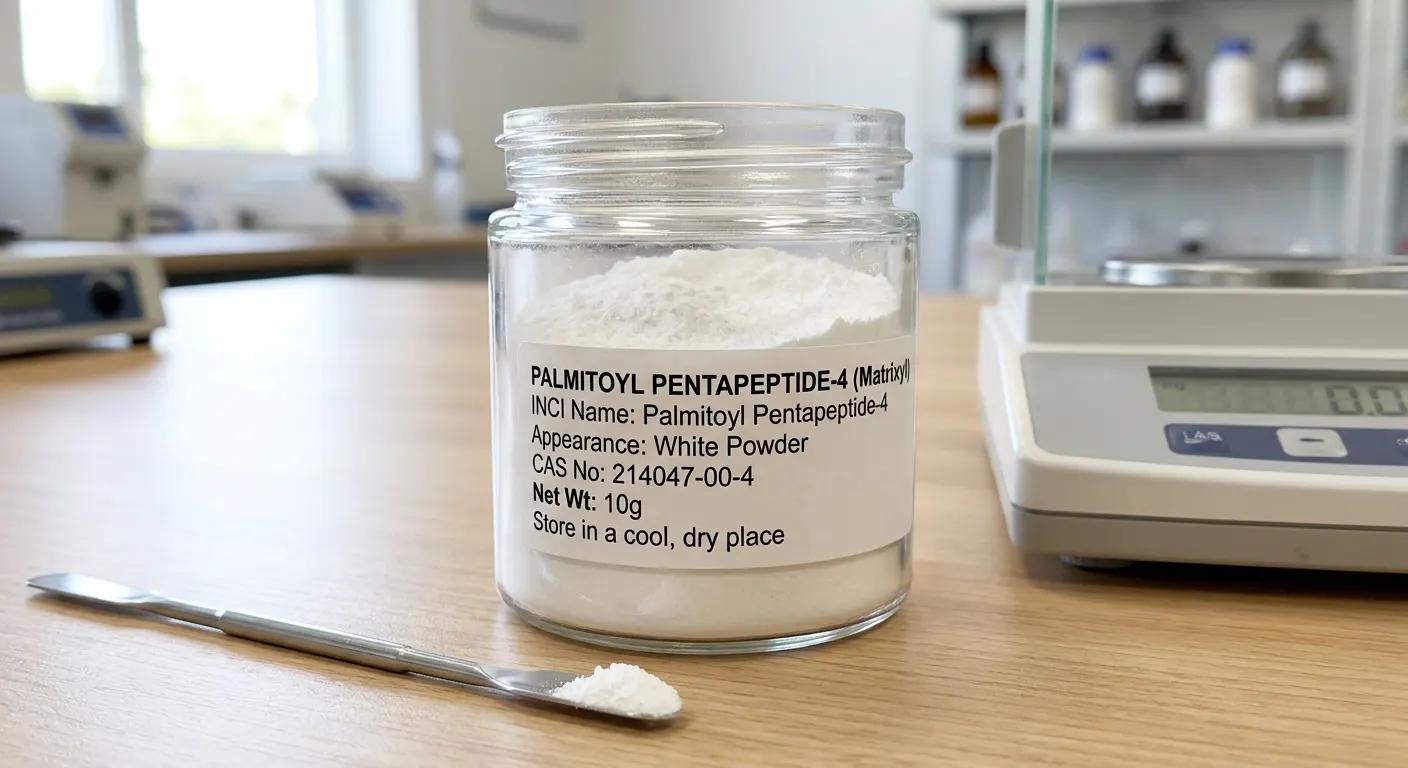
Palmitoyl Pentapeptide-4
Functions / Benefits
Quality Specifications
| Specification Item | Standard |
|---|---|
| Grade | Cosmetic Grade |
| Recommended Usage | 0.001%–0.01% (w/w) in finished formulation |
Description
Is Palmitoyl Pentapeptide-4 (Matrixyl) Effective for Anti-Aging? Benefits, Usage & Formulation Guide Explained
Yes, Palmitoyl Pentapeptide-4 — commercially known as Matrixyl — is one of the most clinically validated cosmetic peptides for anti-aging, with peer-reviewed studies demonstrating measurable reductions in wrinkle depth, increased collagen synthesis, and improved skin firmness at very low use concentrations (0.001%–0.01% w/w).
What Is Palmitoyl Pentapeptide-4?
Palmitoyl Pentapeptide-4 (CAS 214047-00-4) is a synthetic lipopeptide composed of a palmitoyl fatty acid chain conjugated to the pentapeptide sequence Lys-Thr-Thr-Lys-Ser (KTTKS). It was originally developed by Sederma (now a Croda International subsidiary) and is widely recognized under the trade name Matrixyl. Its molecular formula is C₃₉H₇₅N₅O₁₀ with a molecular weight of approximately 802.05 g/mol.
The palmitoyl moiety serves as a lipid delivery vehicle, dramatically improving the peptide’s ability to penetrate the stratum corneum and reach the dermal fibroblasts where it exerts its biological activity. The KTTKS sequence mimics a fragment of procollagen type I — a naturally occurring matrikine released during collagen degradation — which signals fibroblasts to initiate repair and new collagen synthesis.
Palmitoyl Pentapeptide-4 is available as a white to off-white powder with ≥95% purity (HPLC), soluble in water and aqueous formulations, and stable across a broad pH range (4.0–7.5), making it highly compatible with serums, moisturizers, eye creams, and emulsions.
Key Benefits of Palmitoyl Pentapeptide-4
Collagen Synthesis Stimulation. The core mechanism of Palmitoyl Pentapeptide-4 is its ability to act as a matrikine — mimicking the endogenous collagen breakdown fragments that signal fibroblasts to produce new extracellular matrix proteins. In vitro studies on cultured fibroblasts confirmed significant upregulation of collagen type I and type IV synthesis following exposure to Pal-KTTKS. Collagen type I provides tensile strength and firmness; collagen type IV reinforces the basement membrane separating the epidermis from the dermis.
Clinically Proven Wrinkle Reduction. A landmark 12-week randomized controlled trial (Robinson et al., 2005, Int J Cosmet Sci) involving 93 female subjects aged 35–55 demonstrated that Matrixyl-containing moisturizer significantly reduced wrinkle depth and fine lines compared to placebo on a split-face basis. A separate double-blind, randomized, controlled study (Aruan et al., 2023, J Clin Aesthet Dermatol) confirmed that Palmitoyl Pentapeptide-4 cream significantly outperformed placebo and other peptide formulations in reducing periorbital (crow’s feet) wrinkles over eight weeks.
Fibronectin and Elastin Support. Beyond collagen, Palmitoyl Pentapeptide-4 stimulates the production of fibronectin (a glycoprotein critical for cell adhesion and wound healing) and glycosaminoglycans including hyaluronic acid, contributing to improved skin hydration, elasticity, and barrier integrity.
Wound Healing and Scar Modulation. Matrixyl’s origins lie in wound healing research. Studies show it accelerates fibroblast-mediated tissue repair and may downregulate α-smooth muscle actin (α-SMA) expression, reducing myofibroblast differentiation and thereby limiting excessive fibrotic scar formation — a meaningful benefit for post-procedure skin recovery formulations.
Excellent Tolerability. Palmitoyl Pentapeptide-4 is non-irritating, non-sensitizing, and suitable for all skin types including sensitive skin. It is compatible with retinol, vitamin C, niacinamide, and other actives, making it a versatile ingredient for multi-active formulations.
Palmitoyl Pentapeptide-4 (Matrixyl) vs. Matrixyl 3000: Which Is Better?
Matrixyl and Matrixyl 3000 are both developed by Sederma and are among the most widely used peptide complexes in prestige skincare. They share a common goal — collagen stimulation and anti-aging — but differ significantly in composition, mechanism, and scope.
Palmitoyl Pentapeptide-4 (Matrixyl, CAS 214047-00-4) is a single peptide (Pal-KTTKS), a matrikine that mimics procollagen type I fragments, primarily stimulates collagen type I and IV synthesis, has the most extensive clinical evidence base of any cosmetic peptide, is used at 0.001%–0.01% w/w, and is best suited for collagen-focused anti-aging, wrinkle reduction, and skin firming. It is the gold standard for collagen-stimulating peptides.
Matrixyl 3000 is a dual-peptide complex combining Palmitoyl Tripeptide-1 (Pal-GHK) and Palmitoyl Tetrapeptide-7 (Pal-GQPR), where Pal-GHK mimics collagen and Pal-GQPR modulates inflammatory signaling (IL-6 reduction). It offers a broader mechanism covering both collagen synthesis and inflammation modulation, is used at 0.01%–0.1% w/w (as the complex), and is best suited for comprehensive anti-aging addressing both structural decline and chronic low-grade inflammation. It is the preferred choice for multi-mechanism formulations.
Bottom line: Palmitoyl Pentapeptide-4 is the most clinically studied single cosmetic peptide for collagen stimulation and wrinkle reduction, with a stronger evidence base than Matrixyl 3000. Matrixyl 3000 adds an anti-inflammatory dimension that makes it more comprehensive for formulations targeting inflammaging. For maximum efficacy, many premium formulations combine both.
Formulation and Usage Recommendations
Palmitoyl Pentapeptide-4 is effective at very low concentrations: 0.001%–0.01% w/w in finished formulations (equivalent to approximately 0.5–5 ppm of pure peptide). It is water-soluble and should be added to the aqueous phase during formulation at temperatures below 40°C to preserve activity. Optimal pH range is 4.0–7.5.
It is compatible with most cosmetic actives including retinol, niacinamide, vitamin C (at appropriate pH), hyaluronic acid, and other peptides. It combines synergistically with GHK-Cu (for copper-mediated collagen remodeling), Acetyl Hexapeptide-3/SNAP-8 (for expression line reduction), and Palmitoyl Tripeptide-1 / Tetrapeptide-7 (Matrixyl 3000, for broader anti-aging coverage).
Typical finished product applications include anti-aging serums, eye creams, night creams, firming moisturizers, and post-procedure recovery formulations.
Safety and Precautions
Palmitoyl Pentapeptide-4 has an excellent safety profile and is approved for use in cosmetic formulations globally, including under EU Cosmetics Regulation and FDA cosmetic guidelines. It is non-toxic, non-mutagenic, and non-sensitizing at recommended use levels. No significant adverse reactions have been reported in clinical studies.
This ingredient is intended for use in topical cosmetic formulations only and is not for oral consumption. Formulators should conduct standard patch testing and stability assessments for finished products. Always consult with a qualified cosmetic chemist or dermatologist before incorporating new actives into clinical or consumer formulations. These statements have not been evaluated by the Food and Drug Administration. This product is not intended to diagnose, treat, cure, or prevent any disease.