Asiaticoside
Key Benefits
- Wound Healing
- Collagen Synthesis
- Anti-aging
- Anti-inflammatory
- Skin Barrier Repair
- Scar Reduction
- Antioxidant
- Neuroprotection
Product Overview & Specifications
Is Asiaticoside Good for Skin Healing and Anti-aging? Benefits, Uses & Science Explained
Yes, Asiaticoside is one of the most clinically validated wound-healing and collagen-stimulating actives in cosmetic dermatology, derived from the ancient medicinal herb Centella asiatica — and it is the primary bioactive responsible for the plant’s legendary skin-regenerating properties.
What Is Asiaticoside?
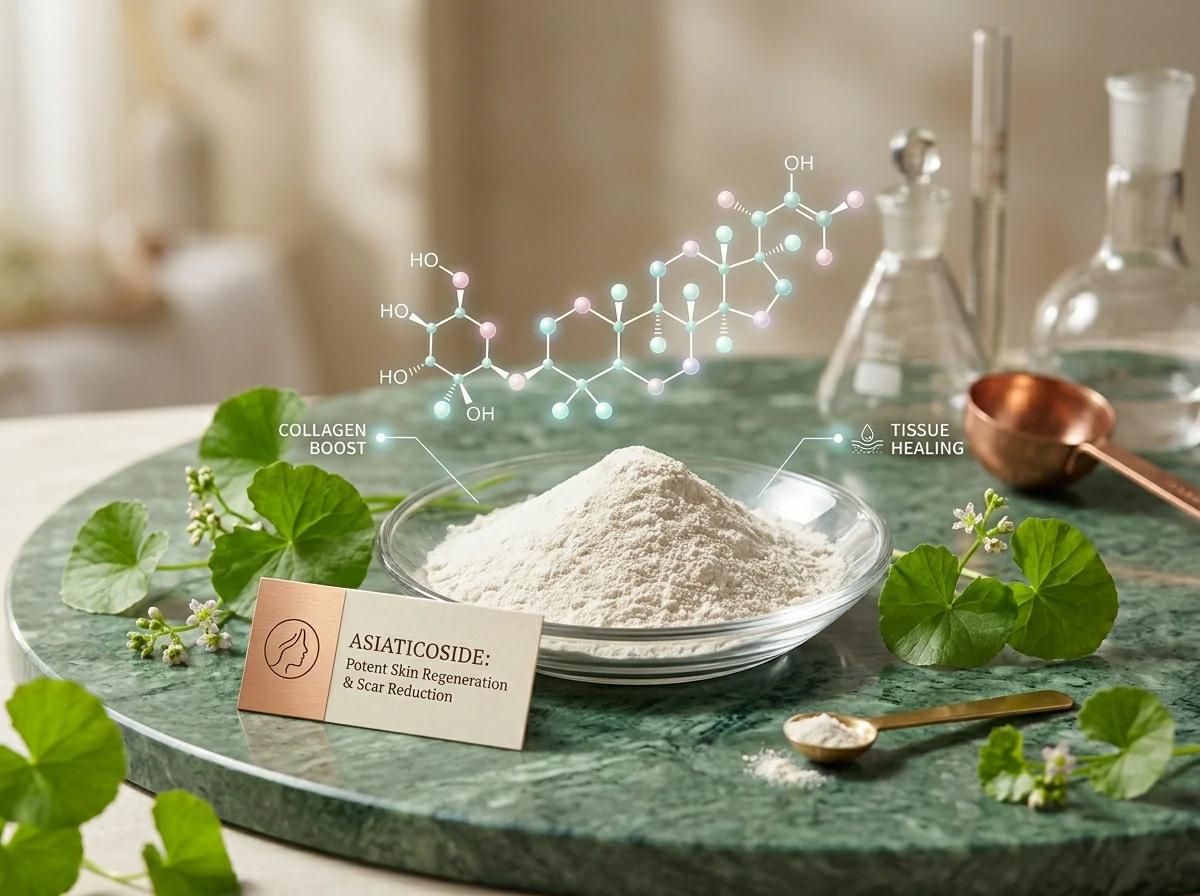
Asiaticoside is a triterpenoid saponin glycoside and the principal bioactive compound of Centella asiatica (Gotu Kola), a herbaceous plant used for millennia in Ayurvedic, Chinese, and Southeast Asian traditional medicine for wound healing, skin rejuvenation, and cognitive support.
Asiaticoside functions as a prodrug: upon topical application or oral ingestion, it is hydrolyzed to its aglycone form, Asiatic acid, which directly activates fibroblast proliferation, collagen synthesis, and skin barrier repair pathways. It is the key active in the clinically proven TECA (Titrated Extract of Centella Asiatica) complex, widely used in pharmaceutical wound-care and scar-treatment formulations.
CAS Number: 16830-15-2
INCI Name: Centella Asiatica Extract
Latin Name: Centella asiatica (L.) Urban
Molecular Formula: C₄₈H₇₈O₁₉
Molecular Weight: 959.12 g/mol
Appearance: White to off-white crystalline powder
Solubility: Slightly soluble in water; soluble in ethanol and DMSO
Available Specs: 90%, 95%, 98% purity
Key Benefits of Asiaticoside
- Wound Healing & Tissue Repair: Stimulates fibroblast proliferation and migration, accelerating wound closure and tissue regeneration. Clinically proven in post-surgical and burn wound management.
- Collagen Synthesis: Upregulates Type I and Type III collagen gene expression via TGF-β signaling, improving skin firmness, elasticity, and density.
- Scar Reduction: Reduces hypertrophic scar and keloid formation by normalizing collagen cross-linking and inhibiting excessive fibroblast activity in scar tissue.
- Skin Barrier Repair: Enhances ceramide production and tight junction protein expression, strengthening the epidermal barrier against environmental stressors.
- Anti-aging: Stimulates collagen neosynthesis and reduces UV-induced matrix metalloproteinase (MMP) activity, slowing photoaging and improving skin texture.
- Anti-inflammatory: Inhibits NF-κB and COX-2 pathways, reducing inflammatory cytokine production and skin redness.
- Antioxidant: Scavenges free radicals and upregulates endogenous antioxidant enzymes (SOD, catalase), protecting skin cells from oxidative damage.
- Neuroprotection: Crosses the blood-brain barrier; studied for cognitive enhancement, anxiety reduction, and neuroprotective effects in Alzheimer’s disease research.
Asiaticoside vs. Madecassoside vs. Asiatic Acid: Which Centella Active Is Best?
Asiaticoside, Madecassoside, and Asiatic Acid are the three primary bioactives of Centella asiatica, each with a distinct chemical structure, mechanism, and optimal application. Understanding their differences is essential for formulating effective Centella-based products.
| Feature | Asiaticoside | Madecassoside | Asiatic Acid |
|---|---|---|---|
| Type | Triterpenoid saponin glycoside | Triterpenoid saponin glycoside | Triterpenoid aglycone |
| CAS Number | 16830-15-2 | 34540-22-2 | 464-92-6 |
| Mechanism | Prodrug → Asiatic acid (hydrolysis) | Prodrug → Madecassic acid (hydrolysis) | Direct bioactive (no conversion needed) |
| Collagen Synthesis | ✅ Strong (TGF-β pathway) | ✅ Strong (TGF-β pathway) | ✅ Very Strong (direct fibroblast activation) |
| Wound Healing | ✅ Strong (clinical TECA data) | ✅ Strong | ✅ Strong |
| Anti-inflammatory | ✅ Strong (NF-κB, COX-2) | ✅ Very Strong (strongest of the three) | ✅ Strong |
| Antioxidant | ✅ Moderate | ✅ Moderate | ✅ Strong |
| Skin Barrier Repair | ✅ Strong | ✅ Strong | ✅ Moderate |
| Scar Reduction | ✅ Strong | ✅ Moderate | ✅ Strong |
| Neuroprotection | ✅ Moderate | ✅ Moderate | ✅ Strong |
| Water Solubility | ✅ Moderate (glycoside) | ✅ Moderate (glycoside) | ⚠️ Poor (aglycone, fat-soluble) |
| Skin Penetration | ✅ Good | ✅ Good | ⚠️ Requires solubilization |
| Oral Bioavailability | ✅ Good (hydrolyzed in GI) | ✅ Good | ✅ Good |
| Topical Usage Rate | 0.1–2% | 0.1–2% | 0.05–1% |
| Best Combined With | Madecassoside, Niacinamide, Peptides | Asiaticoside, Ceramides, Hyaluronic Acid | Asiaticoside, Vitamin C, Retinol |
Verdict: All three Centella actives are highly effective and work synergistically — which is why the most clinically proven formulations (TECA complex) use all three together. Asiaticoside is the most studied and widely used, with the strongest clinical wound-healing evidence base. Madecassoside offers the most potent anti-inflammatory activity. Asiatic Acid provides the most direct collagen-stimulating and antioxidant effects but requires careful solubilization for topical use. For maximum efficacy, combining all three in a standardized Centella extract is the gold standard approach.
Applications
Cosmetic & Skincare:
Used in anti-aging serums, wound-healing creams, scar treatment gels, barrier-repair moisturizers, and post-procedure recovery products. Asiaticoside is water-soluble and compatible with most cosmetic formulation systems. Typical topical usage rate: 0.1–2%. Often formulated as part of a standardized Centella asiatica total extract (TECA) alongside Madecassoside and Asiatic Acid.
Pharmaceutical:
Used in clinically proven wound-care formulations (Madecassol®, Blastoestimulina®) for burn wounds, post-surgical scars, and chronic wound management. Approved pharmaceutical ingredient in multiple countries.
Nutraceuticals & Supplements:
Available in capsules and tablets for cognitive support, anxiety reduction, and systemic anti-inflammatory benefits. Common oral dosage: 30–60 mg/day of standardized extract.
Recommended Usage
- Topical: 0.1–2% in water-based serums, emulsions, or gel formulations. Asiaticoside is best formulated at pH 4.5–6.5 for optimal stability. Combine with Madecassoside, Niacinamide, and Peptides for a comprehensive skin-repair and anti-aging system. Particularly effective in post-procedure recovery and scar-prevention formulations.
- Oral Supplement: 30–60 mg/day of standardized Centella asiatica extract (containing Asiaticoside, Madecassoside, and Asiatic Acid) for general skin health, cognitive support, and systemic anti-inflammatory benefits. Take with food to minimize gastrointestinal discomfort.
- Storage: Store in a cool, dry place away from light and moisture. Recommended storage temperature: below 25°C. Keep tightly sealed to prevent hygroscopic degradation.
Medical Disclaimer: The information provided here is for educational and informational purposes only and is not intended as medical advice. Always consult with a qualified healthcare provider or licensed physician before starting any new supplement regimen or using Asiaticoside for wound care or therapeutic purposes, especially if you are pregnant, nursing, have liver conditions, or are taking prescription medications. Asiaticoside-containing supplements have been associated with rare cases of hepatotoxicity at high doses; do not exceed recommended dosages. Individual results may vary.
Product Performance
- Purity≥90%
- Available specifications90%; 95%
- Latin nameCentella asiatica (L.) Urban
- Usage rate0.1–2% (topical); 30–60 mg/day (oral supplement)
Technical Documentation
COA, MSDS, and HPLC assay report documents are available upon request for each batch.
Request Technical FilesWholesale Sourcing Request
Get HPLC reports, MSDS sheets, and bulk wholesale volume discounts.