Ferulic Acid
Functions / Benefits
Quality Specifications
| Specification Item | Standard |
|---|---|
| Grade | Pharmaceutical Grade |
| Recommended Usage | Topical: 0.5%–1.0% (w/w); Oral supplement: 100–500 mg/day |
| Property 1 | 98% |
| Property 2 | 99% |
Description
Is Ferulic Acid Good for Skin? Benefits, Dosage & Side Effects Explained
Yes, Ferulic Acid is one of the most strategically important antioxidants in modern skincare — not only for its own potent free radical scavenging and UV-absorbing properties, but because it uniquely doubles the photoprotective efficacy of Vitamin C and Vitamin E when combined, making it the essential stabilizing co-antioxidant in the most clinically validated antioxidant serum formulation ever developed.
What Is Ferulic Acid?
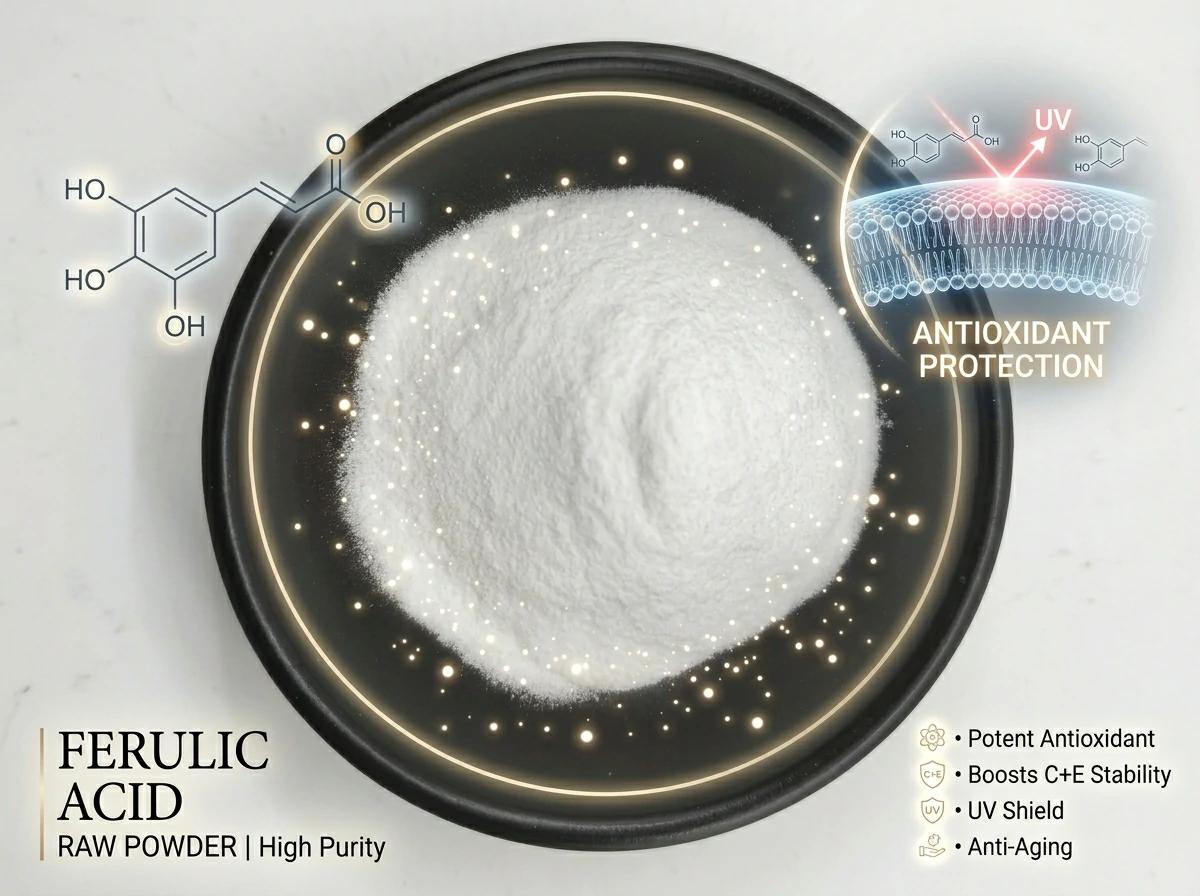
Ferulic Acid (CAS 1135-24-6) is a naturally occurring hydroxycinnamic acid with the molecular formula C₁₀H₁₀O₄ and a molecular weight of 194.18 g/mol. Its INCI name is Ferulic Acid, and it is also known as 4-Hydroxy-3-methoxycinnamic acid or trans-Ferulic Acid. It is found abundantly in the cell walls of plants — particularly in rice bran, wheat bran, oat bran, corn, and coffee — where it is esterified to arabinoxylans and other cell wall polysaccharides.
Ferulic Acid belongs to the hydroxycinnamic acid subclass of phenolic acids and is structurally characterized by a methoxy group and a hydroxyl group on the phenyl ring, plus a propenoic acid side chain with a trans double bond. This conjugated structure enables Ferulic Acid to absorb UV radiation directly (both UVA and UVB), while the phenolic hydroxyl group enables potent free radical scavenging via hydrogen atom donation.
For cosmetic and nutraceutical applications, Ferulic Acid is produced via enzymatic hydrolysis of rice bran feruloyl esters or via chemical synthesis from vanillin. It is available as a white to off-white crystalline powder with ≥98% purity, is sparingly soluble in water (solubility increases significantly at pH above 7.0), and is most stable in acidic conditions (pH 3.0–5.0). It is sensitive to light and oxidation in solution and should be stored in opaque, airtight packaging.
Key Benefits of Ferulic Acid
The CE Ferulic Effect: Doubling Antioxidant Photoprotection. Ferulic Acid’s most clinically significant and commercially important property is its ability to dramatically enhance the stability and photoprotective efficacy of Vitamins C and E. A landmark study (Lin et al., 2005, Journal of Investigative Dermatology) demonstrated that adding 0.5% ferulic acid to a solution of 15% L-Ascorbic Acid (Vitamin C) + 1% alpha-tocopherol (Vitamin E) doubled the photoprotective efficacy of the combination — from a 4-fold reduction in UV-induced oxidative damage to an 8-fold reduction. The same study confirmed that ferulic acid stabilized the vitamin C + E solution against oxidative degradation, extending its shelf life and maintaining potency.
This discovery established the CE Ferulic formulation (Vitamin C 15% + Vitamin E 1% + Ferulic Acid 0.5%, pH 2.5–3.5) as the gold standard antioxidant serum in evidence-based skincare — a formulation that has been validated in multiple subsequent human studies and is now the most widely referenced antioxidant serum in dermatological literature.
The mechanism of ferulic acid’s synergistic effect is threefold: it directly absorbs UV radiation (reducing the photon load that generates ROS), it scavenges free radicals independently, and it regenerates oxidized Vitamin C and Vitamin E back to their active forms — creating a self-reinforcing antioxidant network that is significantly more durable and effective than any single antioxidant alone.
Direct UV Absorption. Ferulic Acid absorbs UV radiation across both the UVA (320–400 nm) and UVB (280–320 nm) spectra, with peak absorption at approximately 322 nm. This direct UV-absorbing capacity provides a sunscreen-like photoprotective effect that complements its antioxidant activity — reducing the amount of UV energy that reaches skin cells and generates reactive oxygen species. While ferulic acid is not classified as a sunscreen active under regulatory frameworks, its UV absorption contributes meaningfully to the overall photoprotective efficacy of formulations containing it.
Hyperpigmentation Reduction and Skin Brightening. Ferulic Acid inhibits tyrosinase — the key enzyme in melanin biosynthesis — reducing melanin production and lightening existing hyperpigmentation, age spots, and post-inflammatory hyperpigmentation (PIH). Its brightening mechanism is complementary to that of Vitamin C (which also inhibits tyrosinase) and niacinamide (which inhibits melanosome transfer), making ferulic acid a valuable component of multi-mechanism brightening formulations.
Collagen Protection and Anti-aging. Ferulic Acid inhibits matrix metalloproteinases (MMPs) — the enzymes that degrade collagen and elastin in response to UV exposure and oxidative stress. By protecting the extracellular matrix from MMP-mediated degradation, ferulic acid helps maintain skin firmness, elasticity, and structural integrity. Combined with its antioxidant and UV-absorbing properties, this MMP-inhibiting activity makes ferulic acid a comprehensive anti-photoaging ingredient.
Anti-inflammatory Activity. Ferulic Acid inhibits the production of pro-inflammatory cytokines (IL-1β, IL-6, TNF-α) and reduces NF-κB signaling, providing meaningful anti-inflammatory effects in skin. These anti-inflammatory properties reduce UV-induced erythema, soothe reactive skin, and contribute to its overall anti-aging and photoprotective benefits.
Systemic Benefits: Cardiovascular, Neuroprotective, and Chemopreventive. Orally, Ferulic Acid provides significant systemic antioxidant and anti-inflammatory benefits. It reduces LDL cholesterol oxidation, improves endothelial function, and has anti-platelet effects — supporting cardiovascular health. It crosses the blood-brain barrier and has demonstrated neuroprotective effects in preclinical models of Alzheimer’s and Parkinson’s disease, inhibiting amyloid-β aggregation and reducing neuroinflammation. Epidemiological studies associate higher dietary ferulic acid intake (from whole grains) with reduced risk of cardiovascular disease, type 2 diabetes, and certain cancers.
Ferulic Acid vs. Other Hydroxycinnamic Acids: Which Is Best for Skin?
Ferulic Acid belongs to the hydroxycinnamic acid family, which includes several structurally related phenolic acids with overlapping but distinct properties. Understanding the differences helps formulators select the optimal compound for specific applications.
Ferulic Acid (CAS 1135-24-6) has a methoxy + hydroxyl substitution pattern on the phenyl ring (3-methoxy-4-hydroxy), absorbs UV across both UVA and UVB (peak ~322 nm), is the most potent antioxidant stabilizer for Vitamin C + E combinations (doubles photoprotective efficacy), inhibits tyrosinase and MMPs, is used at 0.5% w/w in the CE Ferulic formulation, is sparingly water-soluble (best at acidic pH), and is best suited for antioxidant serum formulations requiring maximum photoprotective synergy with Vitamin C and E. It is the gold standard hydroxycinnamic acid for skincare.
Caffeic Acid (CAS 331-39-5) has a dihydroxy substitution pattern on the phenyl ring (3,4-dihydroxy / catechol group), has slightly higher antioxidant potency than ferulic acid in some assay systems (due to the catechol group), absorbs UV primarily in the UVB range, has strong anti-inflammatory and antimicrobial activity, is more water-soluble than ferulic acid, and is best suited for anti-inflammatory and antimicrobial formulations. It is the most potent antioxidant in the hydroxycinnamic acid family but lacks ferulic acid’s unique Vitamin C/E stabilizing synergy.
Sinapic Acid (CAS 530-59-6) has a dimethoxy + hydroxyl substitution pattern (3,5-dimethoxy-4-hydroxy), has the broadest UV absorption spectrum of the hydroxycinnamic acids (absorbs into the UVA range more effectively), has significant antioxidant and anti-inflammatory activity, is found in cruciferous vegetables (mustard, rapeseed), and is best suited for broad-spectrum UV-absorbing formulations. It is an emerging ingredient with growing research interest for photoprotection.
p-Coumaric Acid (CAS 501-98-4) has a single hydroxyl group on the phenyl ring (4-hydroxy), has the lowest antioxidant potency of the major hydroxycinnamic acids, absorbs UV primarily in the UVB range, has anti-inflammatory and antimicrobial activity, is the most water-soluble of the group, and is best suited as a supporting antioxidant in multi-ingredient formulations. It is the simplest and most abundant hydroxycinnamic acid in the human diet.
Bottom line: Ferulic Acid is the optimal hydroxycinnamic acid for skincare formulations — particularly those containing Vitamin C and Vitamin E — due to its unique ability to double the photoprotective efficacy of the C+E combination, its direct UV absorption, tyrosinase inhibition, and MMP-inhibiting activity. For maximum antioxidant and photoprotective performance, the CE Ferulic combination (Vitamin C 15% + Vitamin E 1% + Ferulic Acid 0.5%) remains the gold standard.
Formulation and Usage Recommendations
Topical use: Ferulic Acid is used at 0.5%–1.0% w/w in finished formulations. It is sparingly soluble in water but dissolves readily in ethanol and propylene glycol — pre-dissolve in a small amount of ethanol or propylene glycol before adding to the aqueous phase. Optimal pH range is 2.5–3.5 for the CE Ferulic formulation (required for L-Ascorbic Acid stability and skin penetration). Store in opaque, airtight packaging (amber glass or opaque pump dispensers) to prevent photo-oxidation.
The clinically validated CE Ferulic formulation: L-Ascorbic Acid 15% + alpha-Tocopherol 1% + Ferulic Acid 0.5%, pH 2.5–3.5, applied in the morning before sunscreen. This combination provides 8-fold reduction in UV-induced oxidative damage vs. unprotected skin, and significantly outperforms either antioxidant alone. Apply 4–5 drops to clean, dry face and neck; allow to absorb fully before applying moisturizer and SPF 30+ sunscreen.
Oral supplementation: For systemic antioxidant and cardiovascular benefits, 100–300 mg/day ferulic acid is commonly used. Ferulic acid is also obtained naturally from whole grain consumption (rice bran, wheat bran, oat bran) — a diet rich in whole grains provides meaningful ferulic acid intake without supplementation.
Safety and Precautions
Ferulic Acid has an excellent safety profile for both topical and oral use. Topically, it is non-irritating, non-sensitizing, and suitable for all skin types including sensitive skin at recommended concentrations (0.5%–1.0%). The low pH of CE Ferulic formulations (2.5–3.5) may cause transient stinging in sensitive skin — patch testing is recommended before full-face application. Avoid contact with eyes.
Oral ferulic acid is well tolerated at doses up to 500 mg/day. No significant adverse effects have been reported in clinical studies at standard supplemental doses. Ferulic acid may have mild antiplatelet effects — individuals taking anticoagulant medications (warfarin, aspirin) should consult a healthcare provider before supplementing at high doses.
Always consult with a qualified healthcare provider or cosmetic chemist before incorporating Ferulic Acid into clinical formulations or starting supplementation, especially if you have a pre-existing medical condition, are pregnant or nursing, or are taking prescription medications. These statements have not been evaluated by the Food and Drug Administration. This product is not intended to diagnose, treat, cure, or prevent any disease.