Ginsenosides
Key Benefits
- Anti-aging
- Antioxidant
- Skin Brightening
- Adaptogen
- Immune Support
- Cognitive Enhancement
- Anti-inflammatory
- Energy & Vitality
- Collagen Synthesis
- Anti-cancer Research
Product Overview & Specifications
Are Ginsenosides Good for Anti-aging, Energy, and Skin Health? Benefits, Dosage & Science Explained
Yes, Ginsenosides are the primary bioactive compounds of Panax ginseng — one of the world’s most extensively researched medicinal plants — with clinically documented benefits spanning anti-aging, cognitive enhancement, immune modulation, energy support, and skin brightening.
What Are Ginsenosides?
Ginsenosides (also called Panaxosides) are a class of steroidal saponins unique to the genus Panax, found predominantly in Panax ginseng (Asian/Korean ginseng), Panax quinquefolius (American ginseng), and Panax notoginseng (Tienchi ginseng). Over 150 individual ginsenosides have been identified, each with distinct pharmacological properties.
Ginsenosides are classified into two main structural groups:
- Protopanaxadiol (PPD) group: Rb1, Rb2, Rc, Rd, Rg3, Rh2 — primarily associated with anti-cancer, anti-inflammatory, and neuroprotective effects.
- Protopanaxatriol (PPT) group: Rg1, Re, Rf, Rh1 — primarily associated with CNS stimulation, immune modulation, and adaptogenic effects.
Rare ginsenosides (Rg3, Rh2, Compound K) are produced through fermentation or enzymatic conversion and exhibit significantly enhanced bioavailability and potency compared to native ginsenosides.
CAS Number: 90045-38-8
INCI Name: Panax Ginseng Root Extract
Latin Name: Panax ginseng C.A. Meyer
Molecular Weight: Varies by individual ginsenoside (600–1200 Da)
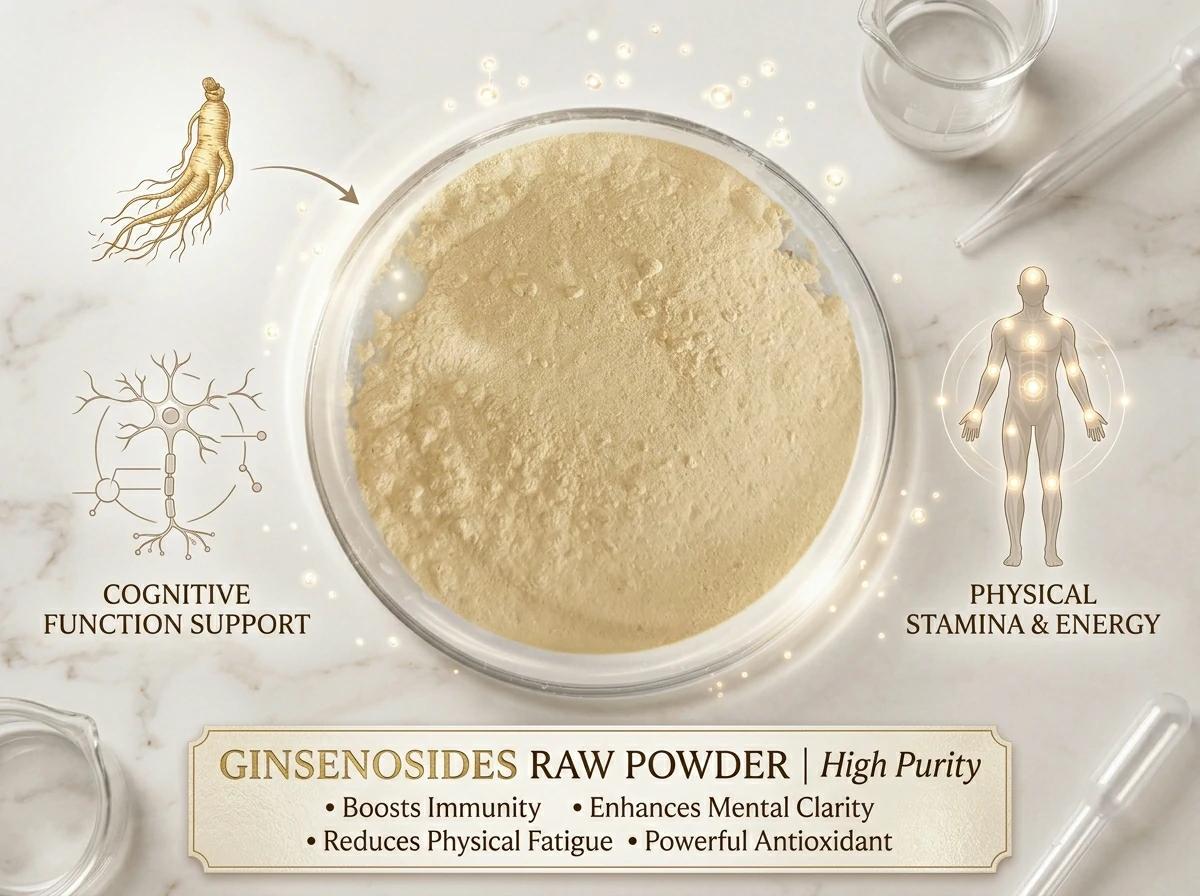
Appearance: Off-white to light yellow powder
Primary Source: Panax ginseng root (6+ year aged preferred)
Available Specs: 10%, 20%, 40%, 80% total ginsenosides; ≥98% single ginsenoside (Rb1, Rg1, Rg3, Rh2)
Key Benefits of Ginsenosides
- Anti-aging & Skin Rejuvenation: Stimulates collagen synthesis, inhibits MMP activity, and reduces UV-induced photoaging. Ginsenoside Rb1 and Rg1 are particularly active in promoting fibroblast proliferation and skin elasticity.
- Skin Brightening: Inhibits tyrosinase activity and melanin synthesis, reducing hyperpigmentation and supporting a more even skin tone.
- Antioxidant: Scavenges free radicals and upregulates endogenous antioxidant enzymes (SOD, catalase, GPx), protecting cells from oxidative damage.
- Adaptogen: Modulates the HPA axis and stress response, helping the body adapt to physical, chemical, and biological stressors — the defining property of ginseng.
- Cognitive Enhancement: Ginsenoside Rg1 and Rb1 support acetylcholine synthesis, neurogenesis, and neuroprotection; studied for Alzheimer’s disease, memory, and focus.
- Immune Modulation: Enhances NK cell activity, T-cell proliferation, and macrophage function; supports both innate and adaptive immunity.
- Energy & Vitality: Improves mitochondrial function and ATP production; reduces fatigue and enhances physical endurance in clinical studies.
- Anti-inflammatory: Inhibits NF-κB, COX-2, and pro-inflammatory cytokine production (TNF-α, IL-1β, IL-6).
- Anti-cancer Research: Ginsenosides Rg3, Rh2, and Compound K are extensively studied for anti-tumor, anti-angiogenic, and chemosensitizing properties (investigational).
- Cardiovascular Support: Improves endothelial function, reduces LDL oxidation, and supports healthy blood pressure and lipid profiles.
Ginsenosides vs. Ashwagandha (Withanolides) vs. Rhodiola (Rosavins): Which Adaptogen Is Best?
Ginsenosides, Withanolides (from Ashwagandha), and Rosavins (from Rhodiola rosea) are the three most clinically studied adaptogenic actives. Each has a distinct mechanism, strength profile, and optimal use case.
| Feature | Ginsenosides (Panax Ginseng) | Withanolides (Ashwagandha) | Rosavins (Rhodiola rosea) |
|---|---|---|---|
| Plant Source | Panax ginseng | Withania somnifera | Rhodiola rosea |
| Adaptogen Class | Saponins (steroidal) | Steroidal lactones | Phenylpropanoids |
| Energy & Vitality | ✅ Strong (ATP, endurance) | ✅ Moderate | ✅ Strong (fatigue reduction) |
| Cognitive Enhancement | ✅ Strong (memory, focus, neuroprotection) | ✅ Moderate (stress-related cognition) | ✅ Strong (mental fatigue, focus) |
| Stress & Cortisol | ✅ Moderate (HPA modulation) | ✅ Very Strong (cortisol reduction) | ✅ Strong (cortisol modulation) |
| Immune Support | ✅ Strong (NK cells, T-cells) | ✅ Moderate | ✅ Moderate |
| Anti-inflammatory | ✅ Strong (NF-κB, COX-2) | ✅ Strong (NF-κB) | ✅ Moderate |
| Antioxidant | ✅ Strong (SOD, catalase) | ✅ Strong | ✅ Strong |
| Skin Anti-aging | ✅ Strong (collagen, MMP inhibition) | ✅ Moderate | ✅ Moderate |
| Skin Brightening | ✅ Strong (tyrosinase inhibition) | ❌ Limited | ❌ Limited |
| Anti-cancer Research | ✅ Strong (Rg3, Rh2, Compound K) | ✅ Moderate (Withaferin A) | ❌ Limited |
| Cardiovascular Support | ✅ Strong | ✅ Moderate | ✅ Moderate |
| Sexual Health | ✅ Strong (erectile function, libido) | ✅ Strong (testosterone support) | ✅ Moderate |
| Oral Bioavailability | Moderate (fermented/rare forms preferred) | Good | Good |
| Topical Application | ✅ Yes (0.1–2%) | ✅ Limited | ❌ Rarely used topically |
| Stimulant Effect | ✅ Mild (PPT group) | ❌ Non-stimulant | ✅ Mild |
| Best Combined With | Ashwagandha, Rhodiola, Vitamin C | Ginsenosides, Magnesium, Zinc | Ginsenosides, B vitamins, CoQ10 |
Verdict: Ginsenosides offer the broadest spectrum of benefits among the three adaptogens, with particular strength in skin anti-aging, brightening, cognitive enhancement, immune support, and anti-cancer research. Ashwagandha leads in cortisol reduction and stress management. Rhodiola excels in acute mental and physical fatigue reduction. For comprehensive adaptogenic support, combining Ginsenosides with Ashwagandha and Rhodiola creates a synergistic multi-pathway formula that addresses energy, stress, cognition, and immunity simultaneously.
Applications
Cosmetic & Skincare:
Used in anti-aging serums, brightening creams, eye contour treatments, and premium facial oils. Ginsenosides are compatible with most cosmetic formulation systems. Typical topical usage rate: 0.1–2%. Ginsenoside Rb1 and Rg1 are the most commonly used individual ginsenosides in cosmetic applications.
Nutraceuticals & Supplements:
Available in capsules, tablets, liquid extracts, and standardized powders. Fermented ginsenoside products (containing rare ginsenosides Rg3, Rh2, Compound K) offer superior bioavailability. Common oral dosage: 200–400 mg/day of standardized extract (containing ≥80% total ginsenosides). Korean Red Ginseng (steam-processed) is preferred for maximum ginsenoside content and bioavailability.
Pharmaceutical:
Approved as a pharmaceutical ingredient in South Korea, China, and several European countries. Ginsenoside Rg3 (Shenyi Capsule®) is approved in China as an adjunct cancer therapy. Extensively investigated for Alzheimer’s disease, diabetes, cardiovascular disease, and immune disorders.
Recommended Usage
- Topical: 0.1–2% in water-based or emulsion formulations. Ginsenosides are water-soluble and compatible with most cosmetic systems. Combine with Vitamin C, Niacinamide, and Peptides for a comprehensive anti-aging and brightening formulation. Stable at pH 4.0–7.0.
- Oral Supplement: 200–400 mg/day of standardized Panax ginseng extract (≥80% total ginsenosides) for general adaptogenic, cognitive, and immune support. Fermented or enzymatically converted products containing rare ginsenosides (Rg3, Rh2, Compound K) are preferred for enhanced bioavailability. Cycle use: 8–12 weeks on, 2–4 weeks off to prevent tolerance.
- Storage: Store in a cool, dry place away from light and moisture. Recommended storage temperature: below 25°C. Keep tightly sealed to prevent hygroscopic degradation.
Medical Disclaimer: The information provided here is for educational and informational purposes only and is not intended as medical advice. Always consult with a qualified healthcare provider or licensed physician before starting any new supplement regimen, especially if you are pregnant, nursing, have hormone-sensitive conditions (estrogen-dependent cancers, endometriosis), diabetes, or are taking blood thinners, immunosuppressants, or stimulant medications. Ginsenosides may interact with warfarin, MAO inhibitors, and diabetes medications. Individual results may vary.
Product Performance
- Purity≥80% (standardized extract); ≥98% (single ginsenoside)
- Available specifications10%; 20%; 40%; 80%; 98%
- Latin namePanax ginseng C.A. Meyer
- Usage rate0.1–2% (topical); 200–400 mg/day (oral supplement)
Technical Documentation
COA, MSDS, and HPLC assay report documents are available upon request for each batch.
Request Technical FilesWholesale Sourcing Request
Get HPLC reports, MSDS sheets, and bulk wholesale volume discounts.