
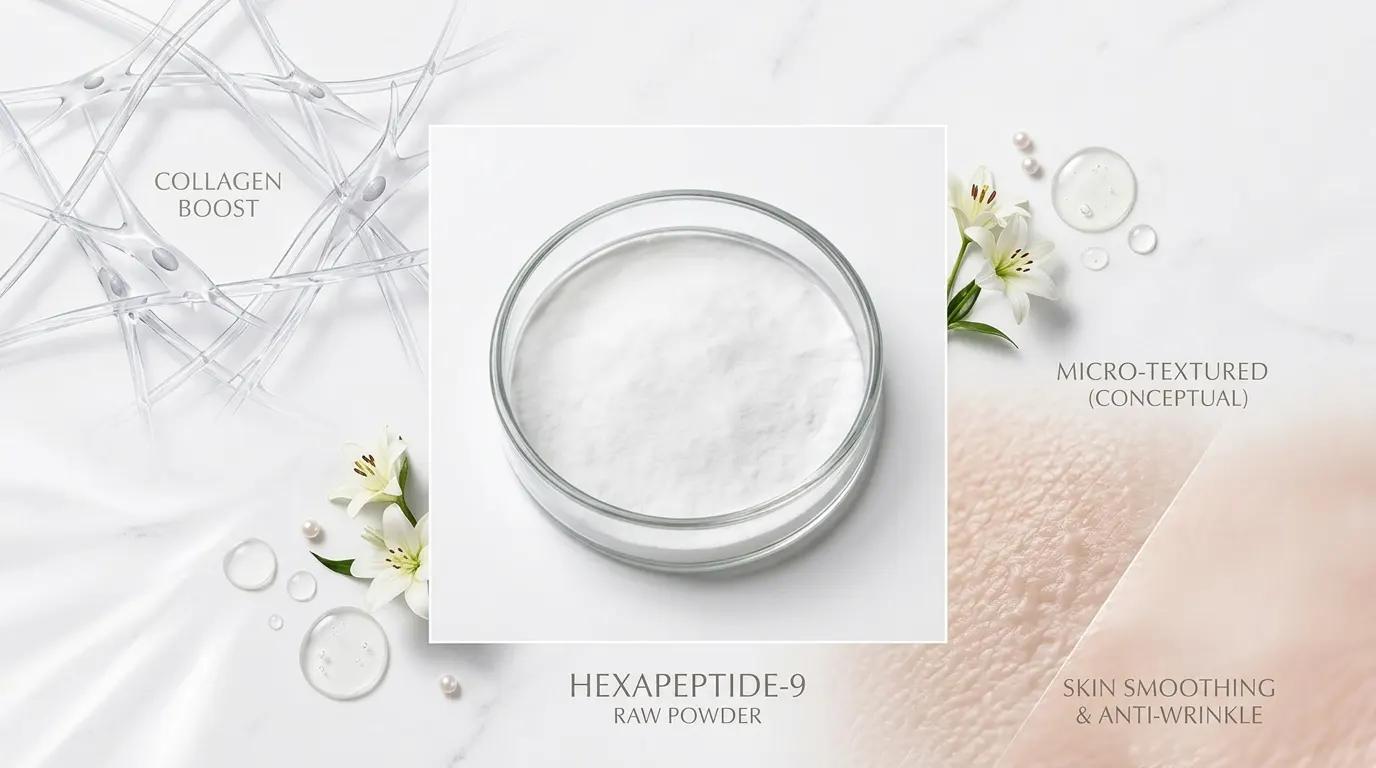
Hexapeptide-9
Functions / Benefits
Quality Specifications
| Specification Item | Standard |
|---|---|
| Grade | Cosmetic Grade |
| Recommended Usage | 1%–5% (w/w) in finished formulation |
| Property 1 | 98% |
Description
Is Hexapeptide-9 (Collaxyl) Effective for Anti-Aging? Benefits, Mechanism & Comparison Guide Explained
Yes, Hexapeptide-9 (Collaxyl) is a clinically validated signal peptide with a unique collagen IV and XVII-mimicking mechanism that stimulates fibroblast collagen production, regenerates the dermal-epidermal junction, and has been shown in a 2025 randomized controlled trial to outperform retinol for long-term wrinkle reduction — with significantly better tolerability.
What Is Hexapeptide-9?
Hexapeptide-9 (CAS 1228371-11-6) is a synthetic signal peptide composed of six amino acids, commercially known as Collaxyl or Collagen Peptide III. Its sequence is engineered to mimic fragments found in human collagen IV and collagen XVII — two key basement membrane collagens that form the structural foundation of the dermal-epidermal junction (DEJ). This structural mimicry gives Hexapeptide-9 a uniquely comprehensive mechanism: it does not merely signal for more collagen, but specifically targets the basement membrane architecture that anchors the epidermis to the dermis and degrades significantly with age.
Hexapeptide-9 is classified as a signal peptide — a biological messenger that binds to receptors on dermal fibroblasts and triggers a cascade of intracellular signaling events that upregulate collagen synthesis genes (COL1A1, COL3A1), activate TGF-β pathways, modulate integrin expression, and enhance ECM remodeling. It is available as a white powder with ≥95% purity (HPLC), water-soluble, and stable across a wide pH range, making it compatible with serums, emulsions, and gels.
Key Benefits of Hexapeptide-9
Collagen Type I and III Stimulation via COL1A1 and COL3A1 Upregulation. Hexapeptide-9 activates fibroblasts to upregulate the expression of COL1A1 (collagen type I alpha 1 chain) and COL3A1 (collagen type III alpha 1 chain) — the two most important structural collagens for skin firmness and elasticity. By binding to collagen receptors on fibroblasts and activating MAPK and PI3K/Akt signaling pathways, it promotes continuous collagen synthesis and ECM reorganization, resulting in a denser, more aligned collagen network with improved mechanical properties.
Dermal-Epidermal Junction (DEJ) Regeneration. One of Hexapeptide-9’s most distinctive capabilities is its ability to regenerate the dermal-epidermal junction — the critical interface between the epidermis and dermis that weakens dramatically with age and UV exposure. By mimicking collagen IV and XVII fragments, Hexapeptide-9 directly stimulates the structural proteins of the basement membrane, restoring the anchoring architecture that gives skin its resilience, thickness, and youthful density. This DEJ-targeting mechanism is shared with very few cosmetic peptides and represents a meaningful differentiation from standard collagen-signaling peptides.
Clinically Outperforms Retinol. A 2025 randomized, double-blinded, active- and vehicle-controlled clinical trial (Chang et al., Journal of Cosmetic Dermatology) demonstrated that Cyclized Hexapeptide-9 (CHP-9) — an advanced cyclized form of Hexapeptide-9 — outperformed retinol in improving skin aging-related symptoms, particularly for long-term use. This is a landmark finding: retinol has been the gold standard for anti-aging for decades, and a peptide demonstrating superior efficacy with better tolerability represents a significant advance for sensitive skin formulations.
Skin Density and Thickness Improvement. Clinical studies confirm that Hexapeptide-9 increases skin density and thickness — two key markers of youthful skin that decline with age as collagen is lost. Improved skin density translates directly to reduced wrinkle depth, improved firmness, and a more resilient complexion.
Anti-inflammatory and Antioxidant Activity. Hexapeptide-9 reduces pro-inflammatory cytokines IL-1β and TNF-α, preventing chronic inflammation-driven collagen degradation. It also activates the Nrf2 antioxidant pathway, upregulating superoxide dismutase (SOD) and catalase to neutralize reactive oxygen species (ROS) and protect skin cells from oxidative aging.
Skin Barrier Enhancement. Hexapeptide-9 promotes the synthesis of barrier lipids and proteins including ceramides and filaggrin, reducing transepidermal water loss (TEWL) and improving moisture retention for softer, more hydrated skin.
Hexapeptide-9 (Collaxyl) vs. Retinol vs. Palmitoyl Pentapeptide-4 (Matrixyl): Which Is Best for Anti-Aging?
Hexapeptide-9, retinol, and Palmitoyl Pentapeptide-4 (Matrixyl) are three of the most widely discussed anti-aging actives in skincare. They differ fundamentally in mechanism, tolerability, and target skin concerns.
Hexapeptide-9 (Collaxyl, CAS 1228371-11-6) is a signal peptide (6 amino acids), mimics collagen IV and XVII basement membrane fragments, stimulates COL1A1 and COL3A1 via MAPK and PI3K/Akt pathways, uniquely regenerates the dermal-epidermal junction, also provides anti-inflammatory and antioxidant activity, is used at 1%–5% w/w, is non-irritating and suitable for all skin types including sensitive skin, and is best suited for comprehensive anti-aging targeting collagen density, DEJ regeneration, and skin thickness. It is the best-tolerated option with the broadest multi-mechanism profile.
Retinol (Vitamin A) is a small molecule (not a peptide), converts to retinoic acid in skin to regulate gene expression, stimulates collagen synthesis and accelerates cell turnover, is the most extensively clinically studied anti-aging active, is used at 0.025%–1% w/w, commonly causes irritation, dryness, and photosensitivity (especially at higher concentrations), and is best suited for accelerated cell turnover, pigmentation correction, and acne. It is the gold standard for clinical evidence but limited by tolerability.
Palmitoyl Pentapeptide-4 (Matrixyl, CAS 214047-00-4) is a matrikine peptide (5 amino acids + palmitoyl), mimics procollagen type I fragments to signal fibroblasts, stimulates collagen types I and IV plus fibronectin, has the strongest standalone clinical evidence base of any cosmetic peptide, is used at 0.001%–0.01% w/w, is non-irritating and suitable for all skin types, and is best suited for targeted collagen stimulation and wrinkle reduction. It is the gold standard for standalone collagen-stimulating peptides.
Bottom line: Hexapeptide-9 offers the most comprehensive multi-mechanism anti-aging profile — combining collagen stimulation, DEJ regeneration, anti-inflammatory, and antioxidant activity — with superior tolerability versus retinol and a higher use concentration than palmitoyl peptides. Retinol remains the most clinically studied active but is limited by irritation potential. Palmitoyl Pentapeptide-4 is the most efficient collagen-signaling peptide at ultra-low concentrations. For maximum anti-aging efficacy, premium formulations increasingly combine Hexapeptide-9 with palmitoyl peptides (Matrixyl, Matrixyl 3000, SYN-COLL) and vitamin C for a comprehensive, multi-pathway approach.
Formulation and Usage Recommendations
Hexapeptide-9 is used at 1%–5% w/w in finished formulations — a notably higher concentration than palmitoyl peptides, reflecting its water-soluble, non-lipidated structure. It should be added to the aqueous phase during formulation at temperatures below 40°C. It is stable across a wide pH range and compatible with most cosmetic actives.
It combines synergistically with vitamin C (a co-factor for collagen synthesis that amplifies Hexapeptide-9’s collagen-stimulating effects), niacinamide (for barrier support and anti-inflammatory coverage), palmitoyl peptides (Matrixyl, Matrixyl 3000, SYN-COLL) for complementary collagen signaling pathways, and GHK-Cu for copper-mediated collagen remodeling. It is particularly well-suited for sensitive skin formulations as a retinol alternative or complement.
Typical finished product applications include anti-aging serums, firming creams, eye creams, night creams, retinol-alternative formulations, and sensitive skin anti-aging products.
Safety and Precautions
Hexapeptide-9 has an excellent safety profile and is approved for use in cosmetic formulations globally, including under EU Cosmetics Regulation and FDA cosmetic guidelines. It is non-toxic, non-mutagenic, and non-sensitizing at recommended use levels. Unlike retinol, it does not cause photosensitivity and can be used in both morning and evening formulations without sun sensitivity concerns.
This ingredient is intended for use in topical cosmetic formulations only and is not for oral consumption. Formulators should conduct standard patch testing and stability assessments for finished products. Always consult with a qualified cosmetic chemist or dermatologist before incorporating new actives into clinical or consumer formulations. These statements have not been evaluated by the Food and Drug Administration. This product is not intended to diagnose, treat, cure, or prevent any disease.