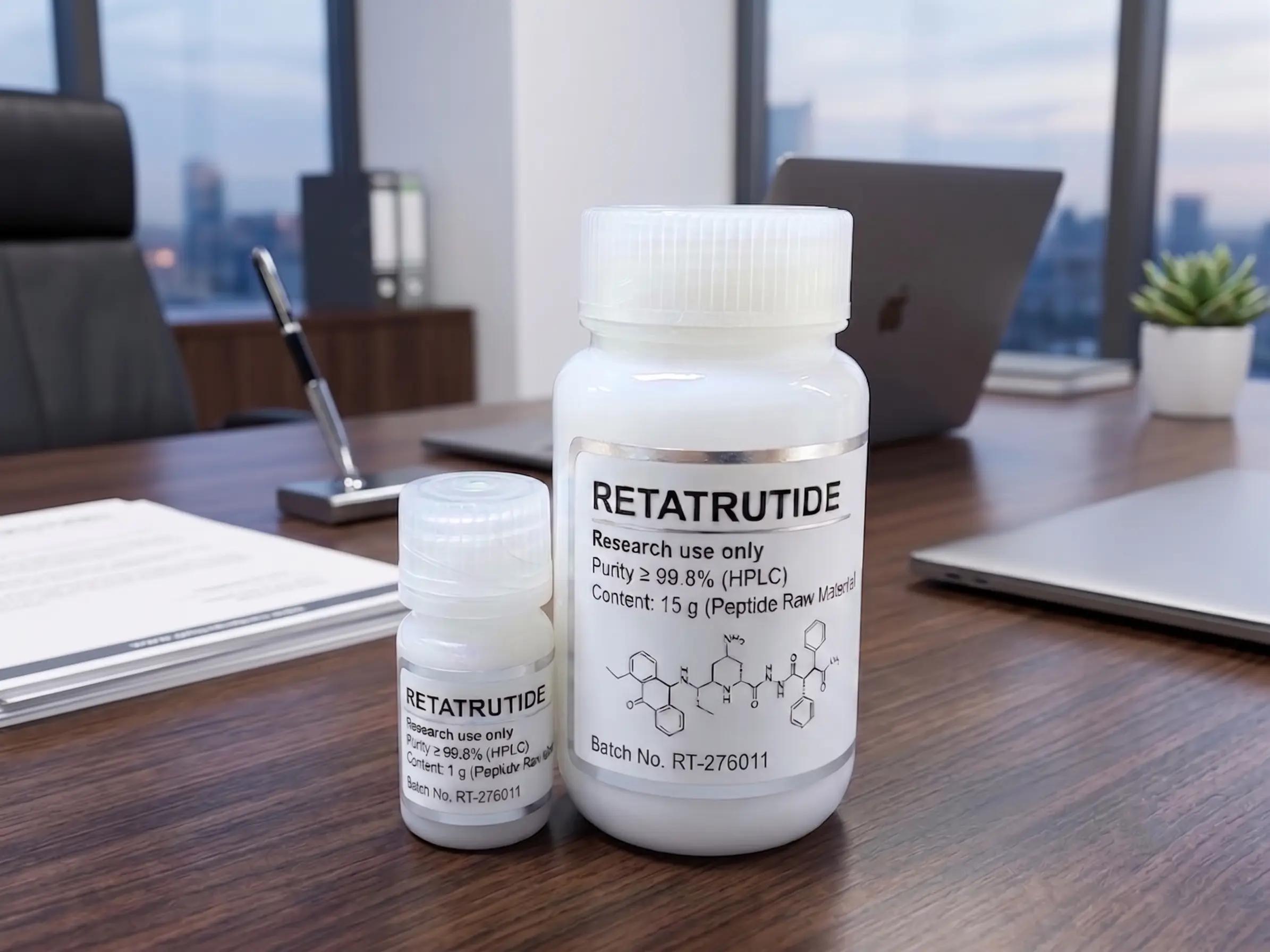
RetatrutideRaw Material
Key Benefits
- GLP-1 receptor agonist
- GIP receptor agonist
- Glucagon receptor agonist
- Triple receptor agonist
- Metabolic research peptide
- Weight management research
Product Overview & Specifications
What Is Retatrutide?
Retatrutide (LY3437943) is an investigational triple receptor agonist peptide developed by Eli Lilly and Company. It is the first therapeutic candidate to simultaneously target three key metabolic receptor pathways — GLP-1 (glucagon-like peptide-1), GIP (glucose-dependent insulinotropic polypeptide), and glucagon — in a single molecule. This novel triple-agonist mechanism distinguishes retatrutide from earlier single-agonist (e.g. semaglutide/Ozempic) and dual-agonist (e.g. tirzepatide/Mounjaro) incretin-based agents.
COSEPP supplies retatrutide as a research-grade lyophilized peptide powder intended exclusively for laboratory and in vitro research applications. This product is NOT approved by the FDA for human therapeutic use and is sold strictly as a chemical reference material for scientific investigation.
As of 2026, retatrutide is undergoing Phase 3 clinical evaluation in the TRIUMPH program. Preliminary data from completed Phase 2 trials have generated considerable scientific interest, particularly regarding body weight reduction outcomes and metabolic parameter improvements.
Triple Receptor Mechanism of Action
Retatrutide's structural design enables balanced agonism across three receptors that each contribute distinct metabolic effects:
GLP-1 Receptor Activation — Suppresses appetite via central nervous system pathways, slows gastric emptying, and promotes glucose-dependent insulin secretion. This is the primary mechanism exploited by semaglutide (Ozempic/Wegovy) and other first-generation GLP-1 receptor agonists.
GIP Receptor Activation — Enhances insulin secretion in a glucose-dependent manner and may improve lipid metabolism and insulin sensitivity. GIP agonism works synergistically with GLP-1 agonism for enhanced glycemic control, as demonstrated by the tirzepatide dual-agonist platform.
Glucagon Receptor Activation — Increases hepatic glucose output, elevates energy expenditure through thermogenesis, and promotes lipolysis (fat breakdown). This third dimension of agonism is what fundamentally differentiates retatrutide from earlier dual-agonists, adding a direct energy-expenditure component that complements the appetite-suppression and insulin-sensitizing effects.
The rationale behind this triple-agonist approach is that simultaneous engagement of all three pathways may produce superior metabolic outcomes compared to targeting any two pathways alone — a hypothesis that early clinical data appear to support.
Key comparison: Retatrutide vs. Tirzepatide vs. Semaglutide
Semaglutide (Ozempic/Wegovy) targets GLP-1 only. Tirzepatide (Mounjaro/Zepbound) targets GLP-1 + GIP. Retatrutide targets GLP-1 + GIP + glucagon. Each additional receptor target adds a distinct metabolic mechanism, and the preclinical and clinical data suggest that the addition of glucagon agonism may confer meaningful incremental benefit, particularly in body weight reduction and visceral fat loss.
Clinical Research Highlights
The following data are extracted from published clinical trials and are presented for informational purposes only. They do not constitute claims about this research product.
In the Phase 2 randomized controlled trial (Jastreboff et al., NEJM 2023), participants receiving the highest retatrutide dose (12 mg weekly) achieved a mean body weight reduction of approximately 24.2% at 48 weeks, compared to 2.1% in the placebo group. Weight loss did not appear to plateau by week 48, suggesting additional reduction may occur with extended treatment duration.
Visceral fat reduction was a notable feature of the study, with MRI-assessed visceral adipose tissue decreasing by up to 40% in the highest dose group. Total body fat mass was reduced while lean mass was relatively preserved — a pattern sometimes described as “favorable body composition partitioning.”
The ongoing Phase 3 TRIUMPH program is evaluating retatrutide across multiple indications including obesity, type 2 diabetes, and obesity-related cardiovascular outcomes. FDA approval status remains pending the completion and review of these trials.
Reconstitution & Handling Protocols
Retatrutide is supplied as a lyophilized (freeze-dried) powder in sterile, sealed glass vials. Proper reconstitution is essential for maintaining peptide integrity in laboratory research settings.
Reconstitution procedure:
1. Allow the lyophilized vial to reach room temperature before reconstitution.
2. Use bacteriostatic water (BAC water / 0.9% benzyl alcohol) or sterile water for injection as the solvent. For a 10 mg vial of retatrutide, adding 1 mL of solvent yields a 10 mg/mL concentration; adding 2 mL yields 5 mg/mL. Researchers should select the volume based on their experimental protocol requirements.
3. Inject solvent slowly down the inner wall of the vial. Do NOT direct the stream onto the peptide cake.
4. Gently swirl (do NOT shake or vortex) until the powder is fully dissolved. The solution should be clear and particle-free.
Storage guidelines:
Unreconstituted powder: Store at -20°C, protected from light and moisture. Stable for the duration indicated on the Certificate of Analysis.
Reconstituted solution: Store at 2–8°C. Use within 28 days. Do not refreeze after reconstitution.
Research Dosing Reference
The following dosing information is derived from published Phase 2 clinical trial protocols and is provided strictly as a research reference. These doses represent the regimens evaluated in controlled clinical settings and are NOT intended as guidance for any human application.
Phase 2 clinical trial dosing schedule (Jastreboff et al., NEJM 2023):
Starting dose: 2 mg once weekly, administered subcutaneously
Escalation groups: Dose increased at 4-week intervals to target maintenance doses of 4 mg, 8 mg, or 12 mg once weekly
Dose escalation protocol: 2 mg (weeks 1–4) → 4 mg (weeks 5–8) → 8 mg (weeks 9–12) for the 8 mg group, with an additional step to 12 mg for the high-dose cohort
For detailed concentration calculations and a complete reference table, please see our dedicated Retatrutide Dosage Guide.
Safety Profile & Research Disclaimers
In published clinical trials, the side effect profile of retatrutide was generally consistent with the GLP-1 receptor agonist class. The most commonly reported adverse events were gastrointestinal in nature:
Nausea (~35-45% of participants at higher doses), vomiting, diarrhea, and constipation. These events were predominantly mild to moderate in severity and tended to diminish over time. Dose-escalation protocols were employed in the trials to improve gastrointestinal tolerability.
Mild headaches were reported in a subset of participants. The Phase 2 data did not identify significant cardiovascular safety concerns, though comprehensive cardiovascular outcomes data are pending from the Phase 3 program.
Hair-related events (transient hair loss or thinning) have been noted in community discussions, though this was not formally documented as a prominent adverse event in the published Phase 2 results. The relationship between rapid weight loss and telogen effluvium (temporary hair shedding) is a recognized phenomenon in the obesity treatment literature and is not unique to retatrutide.
IMPORTANT DISCLAIMER: This product is for laboratory research use only. It is NOT for human consumption, NOT for diagnostic or therapeutic use, and NOT for use in animals. It is sold as a raw material for scientific research and chemical analysis. COSPEP does NOT sell compounded pharmaceutical preparations, pharmacy-compounded formulations, or finished dosage forms. By purchasing this product, the buyer certifies that it will be used exclusively for legitimate research purposes in compliance with all applicable laws and regulations.
Product Performance
- Purity≥98% (HPLC)
- Usage rateFor laboratory research only — see clinical trial references for experimental dose ranges
Technical Documentation
COA, MSDS, and HPLC assay report documents are available upon request for each batch.
Request Technical FilesWholesale Sourcing Request
Get HPLC reports, MSDS sheets, and bulk wholesale volume discounts.