Superoxide Dismutase
Key Benefits
- Antioxidant
- Anti-aging
- Anti-inflammatory
- Free Radical Scavenging
- Skin Repair
- UV Protection
- Enzyme Activity
Product Overview & Specifications
Is Superoxide Dismutase (SOD) Effective for Anti-aging and Skin Protection? Benefits, Uses & Science Explained
Yes, Superoxide Dismutase (SOD) is one of the most powerful antioxidant enzymes in the human body, clinically recognized for its ability to neutralize superoxide radicals — the primary driver of oxidative stress, cellular aging, and inflammation.
What Is Superoxide Dismutase?
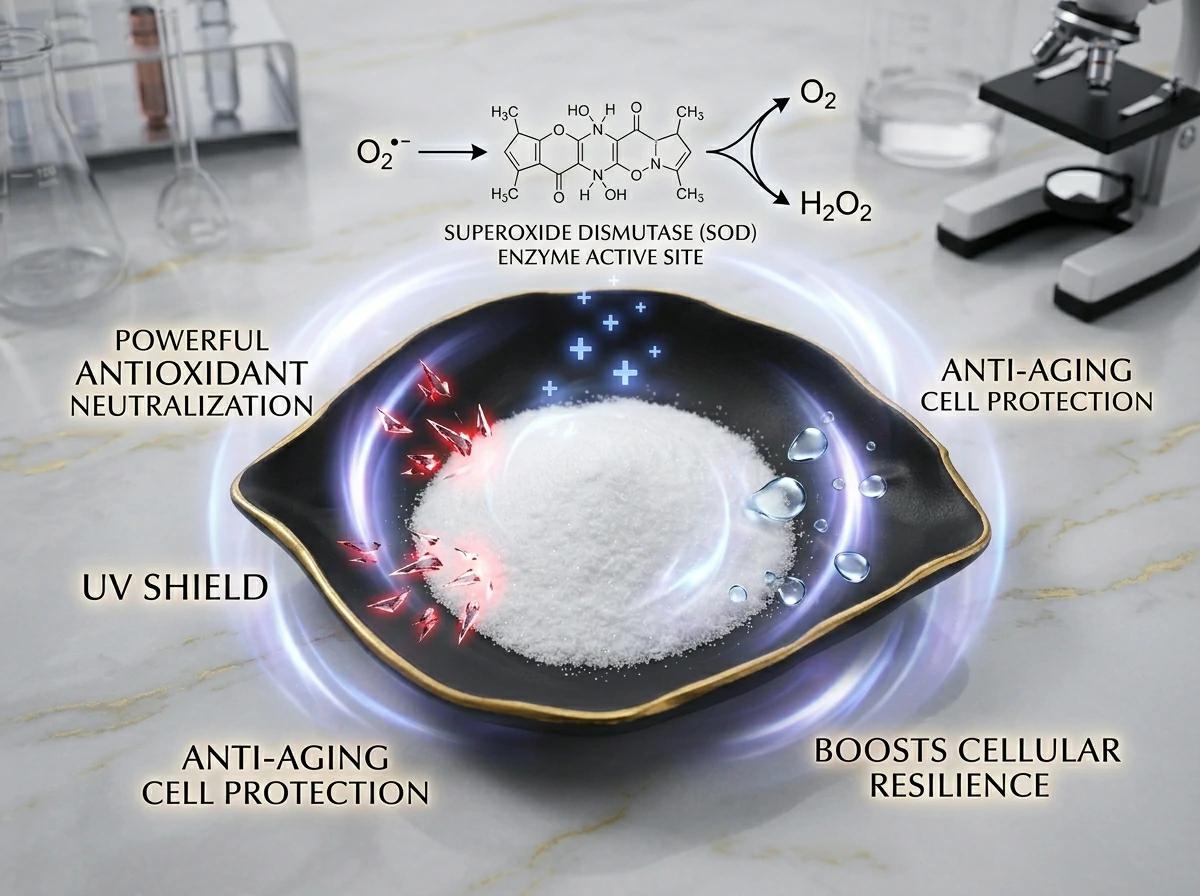
Superoxide Dismutase (SOD) is a metalloenzyme that catalyzes the dismutation of superoxide radicals (O₂⁻) into molecular oxygen (O₂) and hydrogen peroxide (H₂O₂), which is then further neutralized by catalase and glutathione peroxidase. It is the body’s first line of enzymatic defense against oxidative damage.
Three primary isoforms exist in humans:
- SOD1 (Cu/Zn-SOD): Found in the cytoplasm; the most abundant form.
- SOD2 (Mn-SOD): Located in the mitochondria; critical for cellular energy protection.
- SOD3 (EC-SOD): Extracellular form; protects tissues and blood vessels.
CAS Number: 9054-89-1
EC Number: 1.15.1.1
INCI Name: Superoxide Dismutase
Molecular Weight: ~32,000 Da (Cu/Zn-SOD dimer)
Appearance: White to off-white lyophilized powder
Activity: ≥1,000 IU/mg (up to 10,000 IU/mg available)
Solubility: Freely soluble in water
Key Benefits of Superoxide Dismutase
- Free Radical Scavenging: Directly dismutates superoxide radicals — the most reactive and damaging ROS species — at rates near the diffusion limit.
- Anti-aging: Reduces oxidative damage to DNA, proteins, and lipids, slowing cellular senescence and visible skin aging.
- Skin Brightening & Repair: Decreases UV-induced oxidative stress, supporting skin barrier recovery and reducing hyperpigmentation.
- Anti-inflammatory: Suppresses NF-κB signaling and pro-inflammatory cytokine production driven by superoxide.
- UV & Environmental Protection: Shields skin cells from photooxidative damage caused by UV radiation and pollution.
- Mitochondrial Protection: SOD2 preserves mitochondrial integrity, supporting cellular energy metabolism and longevity.
Superoxide Dismutase vs. Glutathione: Which Antioxidant Is More Powerful?
Both SOD and Glutathione are cornerstone antioxidants, but they operate at different stages of the oxidative stress cascade and serve distinct biological roles.
| Feature | Superoxide Dismutase (SOD) | Glutathione (GSH) |
|---|---|---|
| Type | Metalloenzyme | Tripeptide |
| Primary Target | Superoxide radical | Broad-spectrum ROS & toxins |
| Mechanism | Enzymatic catalysis | Direct chemical scavenging |
| Activity Unit | IU/mg (enzyme activity) | mg/g (concentration) |
| Skin Brightening | ✅ Moderate (UV protection) | ✅ Strong (tyrosinase inhibition) |
| Detoxification | ❌ Limited | ✅ Strong (liver phase II) |
| Anti-inflammatory | ✅ Strong (NF-κB suppression) | ✅ Moderate |
| Oral Bioavailability | Low (enzyme degradation in GI) | Moderate (liposomal preferred) |
| Topical Stability | Moderate (encapsulation recommended) | Moderate (oxidation-sensitive) |
| Best Combined With | Catalase, Glutathione, Vitamin C | Vitamin C, SOD, Alpha-lipoic acid |
Verdict: SOD and Glutathione are highly complementary. SOD neutralizes the initial superoxide burst, while Glutathione handles downstream peroxides and toxins. Combining both — alongside Vitamin C and Catalase — creates a comprehensive, multi-layered antioxidant defense system ideal for premium anti-aging and skin-brightening formulations.
Applications
Cosmetic & Skincare:
Used in anti-aging serums, sunscreens, post-procedure recovery creams, and brightening masks. Encapsulated or liposomal forms are recommended for enhanced skin penetration and stability. Typical topical usage rate: 0.1–1%.
Nutraceuticals & Supplements:
Available in enteric-coated capsules, liposomal formulations, and gliadin-bound forms (GliSODin®) for improved oral bioavailability. Common dosage: 100–2000 U/day.
Pharmaceutical & Research:
Investigated for applications in inflammatory diseases, ischemia-reperfusion injury, neurodegenerative conditions, and cancer adjunct therapy.
Recommended Usage
- Topical: 0.1–1% in finished formulations; use encapsulated or liposomal SOD for optimal stability and penetration. Combine with Vitamin C and Glutathione for synergistic antioxidant effect.
- Oral Supplement: 100–500 U/day for general antioxidant support; gliadin-bound forms (GliSODin®) are preferred for oral delivery due to significantly improved bioavailability.
- Storage: Store at 2–8°C, away from light and moisture. Avoid repeated freeze-thaw cycles to preserve enzyme activity.
Medical Disclaimer: The information provided here is for educational and informational purposes only and is not intended as medical advice. Always consult with a qualified healthcare provider or licensed physician before starting any new supplement regimen, particularly if you are pregnant, nursing, have a pre-existing medical condition, or are taking prescription medications. Enzyme activity and efficacy may vary depending on formulation, delivery method, and individual physiology. Individual results may vary.
Product Performance
- Purity≥98%
- Available specifications2000IU/mg; 10000IU/mg
- Latin nameSuperoxide Dismutase (SOD)
- Usage rate0.1–1% (topical); 100–2000 IU/day (oral supplement)
Technical Documentation
COA, MSDS, and HPLC assay report documents are available upon request for each batch.
Request Technical FilesWholesale Sourcing Request
Get HPLC reports, MSDS sheets, and bulk wholesale volume discounts.