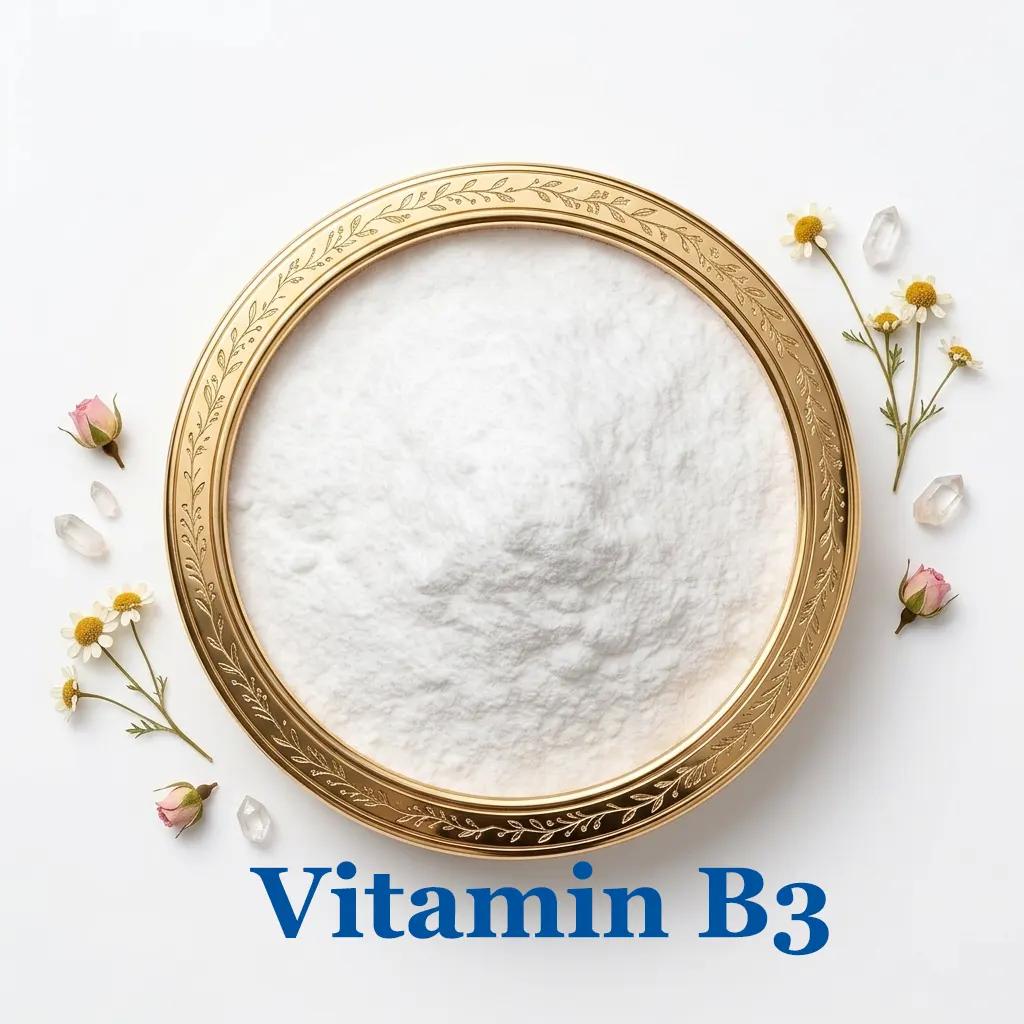
Vitamin B3(Niacinamide)
Functions / Benefits
Quality Specifications
| Specification Item | Standard |
|---|---|
| Grade | Pharmaceutical Grade |
| Recommended Usage | Topical: 2%–10% (w/w); Oral supplement: 14–35 mg NE/day (therapeutic: up to 1,500 mg/day) |
| Property 1 | 99% |
Description
Is Niacinamide Good for Skin? Benefits, Dosage & Side Effects Explained
Yes, Niacinamide (Nicotinamide, Vitamin B3) is one of the most versatile, well-tolerated, and clinically validated skincare actives available, with robust evidence for skin barrier repair, sebum regulation, pore reduction, hyperpigmentation reduction, anti-inflammatory action, and anti-aging — making it the ideal multi-benefit ingredient for virtually every skin type and concern.
What Is Niacinamide?
Niacinamide (CAS 98-92-0) is the amide form of Vitamin B3 (niacin), with the molecular formula C₆H₆N₂O and a molecular weight of 122.12 g/mol. Its INCI name is Niacinamide, and it is also known as Nicotinamide or Pyridine-3-carboxamide. It is distinct from niacin (nicotinic acid, CAS 59-67-6) — both are forms of Vitamin B3, but niacinamide does not cause the “niacin flush” (prostaglandin-mediated skin flushing and redness) associated with high-dose niacin supplementation.
Niacinamide is a water-soluble, highly stable, and pH-neutral active that is compatible with virtually all other skincare ingredients — including retinol, vitamin C, AHAs, BHAs, and peptides. This exceptional compatibility, combined with its broad spectrum of clinically proven benefits and excellent tolerability across all skin types (including sensitive and acne-prone skin), makes it one of the most widely used actives in modern skincare formulation.
Systemically, niacinamide is a precursor to NAD+ (nicotinamide adenine dinucleotide) and NADP+ — essential coenzymes involved in over 400 enzymatic reactions in the human body, including energy metabolism, DNA repair, and cellular signaling. This NAD+ precursor role underpins both its skin benefits (cellular energy for barrier repair and collagen synthesis) and its systemic health benefits (metabolic support, neuroprotection, cardiovascular health).
Niacinamide is available as a white crystalline powder with ≥99% purity (HPLC), is freely soluble in water, and is stable across a wide pH range (3.0–7.5) and temperature range, making it one of the easiest actives to formulate with.
Key Benefits of Niacinamide
Skin Barrier Reinforcement and Ceramide Synthesis. Niacinamide’s most fundamental skin benefit is its ability to strengthen the epidermal barrier. It stimulates the synthesis of ceramides, free fatty acids, and cholesterol — the three key lipid components of the stratum corneum’s lamellar bilayer structure. A landmark study (Tanno et al., 2000, British Journal of Dermatology) demonstrated that topical niacinamide significantly increased ceramide and free fatty acid levels in the stratum corneum, improving barrier function and reducing transepidermal water loss (TEWL). This barrier-reinforcing effect makes niacinamide particularly valuable for dry, sensitive, and compromised skin, and as a supporting ingredient alongside potentially irritating actives like retinol and AHAs.
Sebum Regulation and Pore Size Reduction. Niacinamide reduces sebum excretion rate (SER) by inhibiting the transfer of lipids from sebocytes to the follicular canal. A double-blind, randomized controlled trial (Draelos et al., 2006, Journal of Cosmetics and Laser Therapy) demonstrated that 2% niacinamide significantly reduced sebum production and improved pore appearance after 4 weeks. By reducing sebum and preventing pore-clogging, niacinamide produces measurable reductions in visible pore size — one of the most sought-after cosmetic outcomes in skincare.
Hyperpigmentation Reduction and Skin Brightening. Niacinamide reduces hyperpigmentation through a unique mechanism: it inhibits the transfer of melanosomes (melanin-containing vesicles) from melanocytes to surrounding keratinocytes, without inhibiting melanin synthesis itself. This melanosome transfer inhibition reduces the visible accumulation of pigment in the epidermis, lightening existing hyperpigmentation, age spots, post-inflammatory hyperpigmentation (PIH), and melasma. A randomized controlled trial (Hakozaki et al., 2002, British Journal of Dermatology) confirmed that 5% niacinamide significantly reduced hyperpigmentation and improved skin tone evenness after 8 weeks, with effects comparable to 4% hydroquinone in some studies.
Anti-inflammatory and Redness Reduction. Niacinamide has well-documented anti-inflammatory properties in skin. It inhibits the production of pro-inflammatory cytokines (IL-1β, IL-6, TNF-α), reduces UV-induced immunosuppression, and decreases skin redness and blotchiness. These anti-inflammatory effects make it particularly effective for rosacea, acne-prone skin, and post-procedure skin recovery. Unlike many anti-inflammatory actives, niacinamide achieves these effects without the irritation or sensitization risk associated with corticosteroids or strong botanical extracts.
Anti-aging and Collagen Stimulation. Niacinamide stimulates collagen synthesis in dermal fibroblasts and reduces the appearance of fine lines and wrinkles. A double-blind, vehicle-controlled study (Bissett et al., 2004, Dermatologic Surgery) demonstrated that 5% niacinamide significantly improved fine lines, wrinkles, hyperpigmentation, skin texture, and skin tone after 12 weeks. Its NAD+ precursor role also supports cellular energy production and DNA repair in skin cells, contributing to anti-aging effects at the cellular level.
Acne Treatment. Niacinamide is an effective acne treatment through multiple mechanisms: sebum reduction (reducing comedone formation), anti-inflammatory action (reducing inflammatory acne lesions), and barrier reinforcement (preventing secondary infection and post-acne PIH). A randomized controlled trial (Shalita et al., 1995, International Journal of Dermatology) found that 4% niacinamide gel was as effective as 1% clindamycin gel for treating inflammatory acne, without the antibiotic resistance concerns associated with topical antibiotics.
NAD+ Precursor: Systemic and Cellular Benefits. As a direct precursor to NAD+, niacinamide supports mitochondrial energy production, DNA damage repair (via PARP activation), and cellular signaling pathways involved in longevity (sirtuins). Oral niacinamide supplementation has been shown to reduce the risk of non-melanoma skin cancer in high-risk individuals (Chen et al., 2015, New England Journal of Medicine: 500 mg twice daily reduced new non-melanoma skin cancers by 23% in high-risk patients).
Niacinamide vs. Niacin (Nicotinic Acid): Which Vitamin B3 Is Better for Skin?
Niacinamide and Niacin are both forms of Vitamin B3, but they have fundamentally different properties, mechanisms, and use cases — and are not interchangeable in skincare or supplementation.
Niacinamide (Nicotinamide, CAS 98-92-0) is the amide form of Vitamin B3, is water-soluble and pH-neutral, does NOT cause niacin flush (no prostaglandin D2 release), is the preferred form for topical skincare (barrier repair, sebum control, brightening, anti-aging), is used at 2%–10% w/w topically, is compatible with all skincare actives (retinol, vitamin C, AHAs, peptides), is well tolerated by all skin types including sensitive skin, and is the preferred oral form for NAD+ precursor benefits and skin cancer prevention (500 mg twice daily). It is the gold standard Vitamin B3 for both topical skincare and oral supplementation.
Niacin (Nicotinic Acid, CAS 59-67-6) is the acid form of Vitamin B3, is water-soluble but acidic (pH-lowering in formulations), causes niacin flush at doses above 50 mg (prostaglandin D2-mediated skin flushing, redness, itching — harmless but uncomfortable), is NOT used in topical skincare due to flush risk and formulation challenges, is the preferred oral form for lipid management (reduces LDL cholesterol, raises HDL cholesterol, lowers triglycerides) at therapeutic doses (1,000–3,000 mg/day), and requires medical supervision at therapeutic doses due to hepatotoxicity risk at high doses. It is the preferred Vitamin B3 form for cardiovascular lipid management under medical supervision.
Bottom line: For topical skincare, niacinamide is the only appropriate Vitamin B3 form — niacin is not used topically. For oral supplementation targeting NAD+ support, skin health, and general wellness, niacinamide is preferred due to its flush-free profile. For cardiovascular lipid management (cholesterol/triglyceride reduction), niacin (nicotinic acid) is more effective but requires medical supervision. The two forms are not interchangeable for therapeutic purposes.
Formulation and Usage Recommendations
Topical use: Niacinamide is used at 2%–10% w/w in finished formulations. It is water-soluble and should be added to the aqueous phase. It is stable across pH 3.0–7.5 and temperatures up to 80°C, making it one of the most formulation-friendly actives available. Optimal concentration for most benefits is 5% — higher concentrations (up to 10%) may provide additional sebum control and brightening benefits but can cause mild flushing in some individuals at concentrations above 5%.
Niacinamide is compatible with and synergistic alongside retinol (barrier support reduces retinol-induced irritation), vitamin C (complementary brightening mechanisms), AHAs/BHAs (barrier repair after exfoliation), peptides (comprehensive anti-aging coverage), hyaluronic acid (hydration + barrier), and zinc (enhanced sebum control and acne treatment). It can be used morning and evening and does not increase photosensitivity.
Oral supplementation: The RDA for Vitamin B3 is 14–16 mg NE/day for adults. For NAD+ support and general wellness, 250–500 mg niacinamide/day is commonly used. For skin cancer prevention in high-risk individuals, 500 mg twice daily (1,000 mg/day) has clinical evidence. The tolerable upper intake level (UL) for niacinamide is 35 mg/day from supplements in the US (note: this UL applies to niacin flush risk; niacinamide does not cause flush and is generally well tolerated at higher doses in clinical studies, but consult a healthcare provider for doses above 500 mg/day).
Safety and Precautions
Niacinamide has an excellent safety profile for both topical and oral use. Topically, it is non-irritating, non-sensitizing, and suitable for all skin types including sensitive, acne-prone, and rosacea-prone skin. At concentrations above 5%, some individuals may experience mild, transient flushing — this is rare and distinct from the niacin flush associated with nicotinic acid. Patch testing is recommended for individuals with known sensitivities.
Oral niacinamide is well tolerated at doses up to 1,500 mg/day in clinical studies. At very high doses (above 3,000 mg/day), niacinamide may cause liver toxicity, nausea, and elevated liver enzymes — though this risk is significantly lower than with niacin (nicotinic acid) at equivalent doses. Individuals with liver disease, diabetes, or gout should consult a healthcare provider before supplementing with high-dose niacinamide.
Always consult with a qualified healthcare provider or dermatologist before starting high-dose niacinamide supplementation or incorporating new actives into clinical formulations, especially if you have a pre-existing medical condition, are pregnant or nursing, or are taking prescription medications. These statements have not been evaluated by the Food and Drug Administration. This product is not intended to diagnose, treat, cure, or prevent any disease.