
Palmitoyl Tetrapeptide-7
Functions / Benefits
Quality Specifications
| Specification Item | Standard |
|---|---|
| Grade | Cosmetic Grade |
| Recommended Usage | 0.001%–0.01% (w/w) in finished formulation |
| Property 1 | 98% |
Description
Is Palmitoyl Tetrapeptide-7 (Pal-GQPR) Effective for Anti-Aging? Benefits, Mechanism & Comparison Guide Explained
Yes, Palmitoyl Tetrapeptide-7 (Pal-GQPR) is a clinically relevant cosmetic peptide with a unique anti-inflammatory mechanism — it inhibits interleukin-6 (IL-6) production, directly targeting inflammaging, while simultaneously stimulating collagen renewal, laminin synthesis, and elastin production to firm and rejuvenate aging skin.
What Is Palmitoyl Tetrapeptide-7?
Palmitoyl Tetrapeptide-7 (CAS 221227-05-0) is a synthetic lipopeptide composed of four amino acids — glycine (G), glutamine (Q), proline (P), and arginine ® — conjugated to a palmitoyl (C16 fatty acid) chain at the N-terminus. It is widely known by its shorthand Pal-GQPR, reflecting its amino acid sequence. Its molecular formula is C″H₆N₈O₈ with a molecular weight of approximately 757.97 g/mol.
The GQPR sequence is derived from a fragment of immunoglobulin G (IgG) — the body’s own immune protein — giving Palmitoyl Tetrapeptide-7 a biologically meaningful anti-inflammatory signaling identity. The palmitoyl moiety enhances skin penetration through the stratum corneum, delivering the active peptide to dermal fibroblasts and immune-active cells in the dermis.
Palmitoyl Tetrapeptide-7 is best known as the anti-inflammatory component of Matrixyl 3000, the patented peptide complex developed by Sederma (Croda International), where it is paired with Palmitoyl Tripeptide-1 (Pal-GHK) to create a dual-action collagen-stimulating and inflammaging-targeting system. It is available as a white to off-white powder with ≥95% purity (HPLC), water-soluble, and stable across a pH range of 4.0–7.5.
Key Benefits of Palmitoyl Tetrapeptide-7
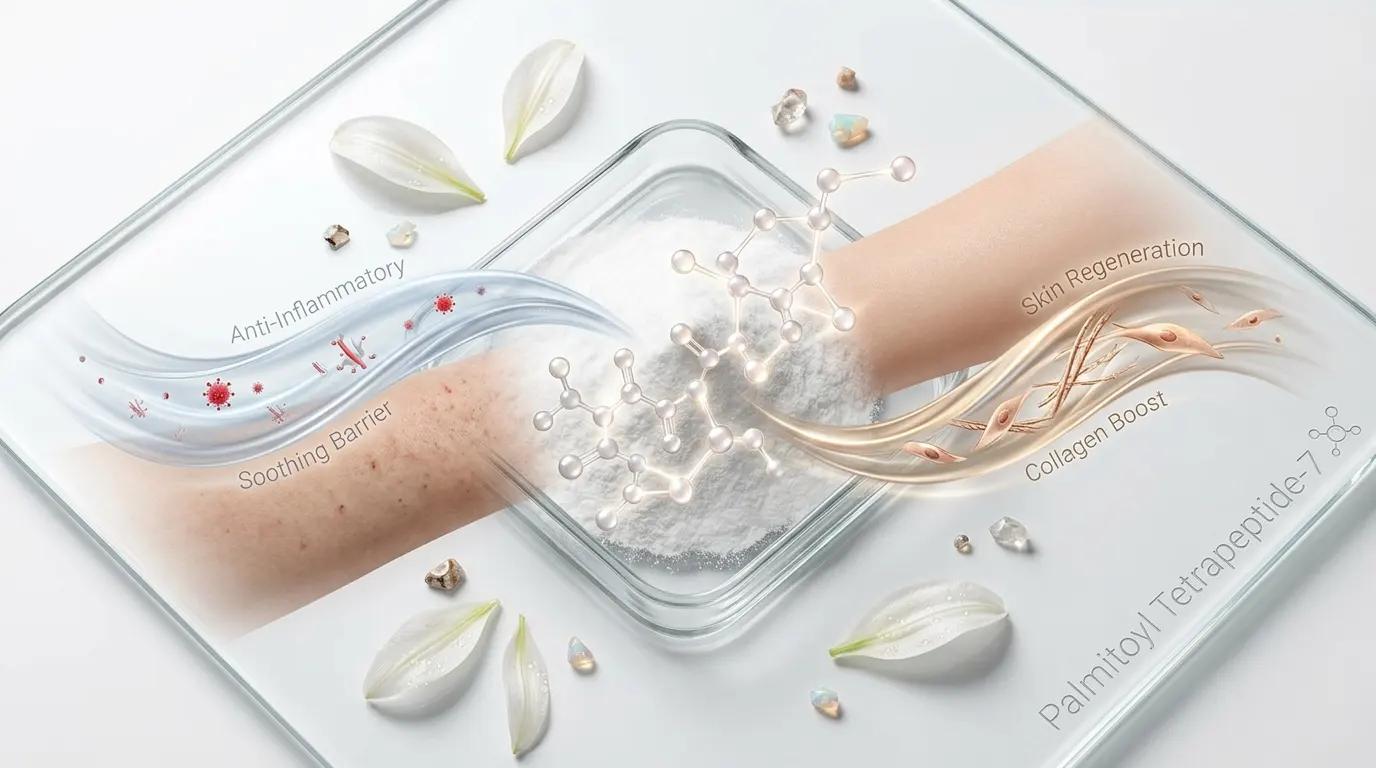
IL-6 Inhibition: Targeting Inflammaging at the Source. The primary and most distinctive mechanism of Palmitoyl Tetrapeptide-7 is its ability to reduce the secretion of interleukin-6 (IL-6) — a key pro-inflammatory cytokine that drives chronic low-grade skin inflammation (inflammaging). IL-6 is chronically elevated in aging skin and is directly responsible for accelerating collagen degradation, impairing fibroblast function, and promoting the visible signs of skin aging. By suppressing IL-6 production, Pal-GQPR addresses one of the most fundamental but often overlooked drivers of skin aging. Research by Xing et al. also confirmed that Palmitoyl Tetrapeptide-7 shifts inflammatory signaling toward an anti-inflammatory phenotype, with lower IL-6 and TNF-α and higher IL-10 in macrophage-like cultures.
Collagen Renewal and ECM Stimulation. Beyond its anti-inflammatory action, Palmitoyl Tetrapeptide-7 stimulates collagen renewal and inhibits collagen degradation. In a landmark study by Mondon et al., a blend containing Palmitoyl Tetrapeptide-7 and Palmitoyl Tripeptide-1 produced increases in collagen I (+258%), fibronectin (+164%), and hyaluronic acid (+179%) versus solvent controls in confluent dermal fibroblast cultures. A separate study by Yang et al. confirmed upregulation of collagen type I alpha 1 chain mRNA (1.8-fold), collagen type III alpha 1 chain mRNA (2.5-fold), collagen type IV alpha 1 chain mRNA (2.8-fold), elastin mRNA (5-fold), and fibronectin mRNA (1.6-fold), with corresponding increases in protein synthesis confirmed by immunofluorescence staining.
Laminin IV and V Stimulation. Palmitoyl Tetrapeptide-7 uniquely stimulates the production of laminin IV and V — structural glycoproteins that form the epidermal-dermal junction (EDJ), the critical interface that anchors the epidermis to the dermis. The EDJ weakens significantly with age and UV exposure, contributing to skin thinning, loss of resilience, and impaired barrier function. By reinforcing laminin production, Pal-GQPR supports the structural integrity of the entire skin architecture, not just the collagen matrix.
UVB Damage Mitigation. Studies indicate that Palmitoyl Tetrapeptide-7 reduces inflammation following UVB exposure, providing a protective effect against photoaging-induced inflammatory cascades that accelerate collagen breakdown and pigmentation irregularities.
Wound Healing Support. In an in vivo hyperglycemia-associated full-thickness wound model, Palmitoyl Tetrapeptide-7 improved wound closure to over 95% by day 21, with increased collagen deposition, reduced IL-6 and TNF-α, and elevated IL-10 and CD31 signals — indicating reduced inflammatory burden alongside enhanced angiogenesis-related markers.
Palmitoyl Tetrapeptide-7 (Pal-GQPR) vs. Palmitoyl Tripeptide-1 (Pal-GHK): Which Is Better?
Palmitoyl Tetrapeptide-7 and Palmitoyl Tripeptide-1 are the two peptides that together form Matrixyl 3000. They are designed to work synergistically, not competitively — but understanding their individual roles is essential for formulators choosing between standalone use and complex formulation.
Palmitoyl Tetrapeptide-7 (Pal-GQPR, CAS 221227-05-0) is a tetrapeptide (Pal-GQPR), derived from an IgG fragment, primarily acts as an anti-inflammatory agent via IL-6 and TNF-α inhibition, also stimulates collagen renewal, laminin IV & V, and elastin, uniquely reinforces the epidermal-dermal junction, provides UVB damage mitigation, is used at 0.001%–0.01% w/w, and is best suited for inflammaging-targeted formulations, photoaged skin, and as the anti-inflammatory half of Matrixyl 3000. It is the essential anti-inflammatory component of Matrixyl 3000.
Palmitoyl Tripeptide-1 (Pal-GHK, CAS 147732-56-7) is a tripeptide (Pal-GHK), mimics collagen fragments (matrikine pathway), primarily stimulates collagen types I and III synthesis plus glycosaminoglycans (including hyaluronic acid), supports skin hydration and UV resistance, is used at 0.001%–0.01% w/w, and is best suited for collagen rebuilding, skin firming, and hydration support. It is the collagen-signaling half of Matrixyl 3000.
Bottom line: Palmitoyl Tetrapeptide-7 and Palmitoyl Tripeptide-1 are complementary, not interchangeable. Pal-GQPR addresses the inflammatory root cause of aging skin; Pal-GHK rebuilds the collagen structure. Together as Matrixyl 3000, they create a comprehensive anti-aging system that is more effective than either peptide alone. For formulators seeking maximum anti-aging coverage, combining both peptides — along with Palmitoyl Tripeptide-5 (SYN-COLL) for TGF-β activation and Palmitoyl Pentapeptide-4 (Matrixyl) for additional matrikine signaling — represents the current gold standard in peptide-based anti-aging formulation.
Formulation and Usage Recommendations
Palmitoyl Tetrapeptide-7 is effective at very low concentrations: 0.001%–0.01% w/w in finished formulations. It is water-soluble and should be added to the aqueous phase during formulation at temperatures below 40°C to preserve peptide integrity. Optimal pH range is 4.0–7.5.
It is compatible with most cosmetic actives including retinol, niacinamide, vitamin C (at appropriate pH), hyaluronic acid, and other peptides. It combines synergistically with Palmitoyl Tripeptide-1 (to form a Matrixyl 3000-equivalent complex for combined collagen + anti-inflammatory activity), Palmitoyl Tripeptide-5 / SYN-COLL (for TGF-β-mediated collagen stimulation and MMP inhibition), Palmitoyl Pentapeptide-4 / Matrixyl (for additional matrikine collagen signaling), and GHK-Cu (for copper-mediated collagen remodeling and wound healing).
Typical finished product applications include anti-aging serums, eye creams, night creams, firming moisturizers, post-sun recovery formulations, and multi-peptide complex formulations targeting inflammaging and structural skin decline.
Safety and Precautions
Palmitoyl Tetrapeptide-7 has an excellent safety profile and is approved for use in cosmetic formulations globally, including under EU Cosmetics Regulation and FDA cosmetic guidelines. It is non-toxic, non-mutagenic, and non-sensitizing at recommended use levels. No significant adverse reactions have been reported in clinical studies at standard cosmetic use concentrations.
This ingredient is intended for use in topical cosmetic formulations only and is not for oral consumption. Formulators should conduct standard patch testing and stability assessments for finished products. Always consult with a qualified cosmetic chemist or dermatologist before incorporating new actives into clinical or consumer formulations. These statements have not been evaluated by the Food and Drug Administration. This product is not intended to diagnose, treat, cure, or prevent any disease.