
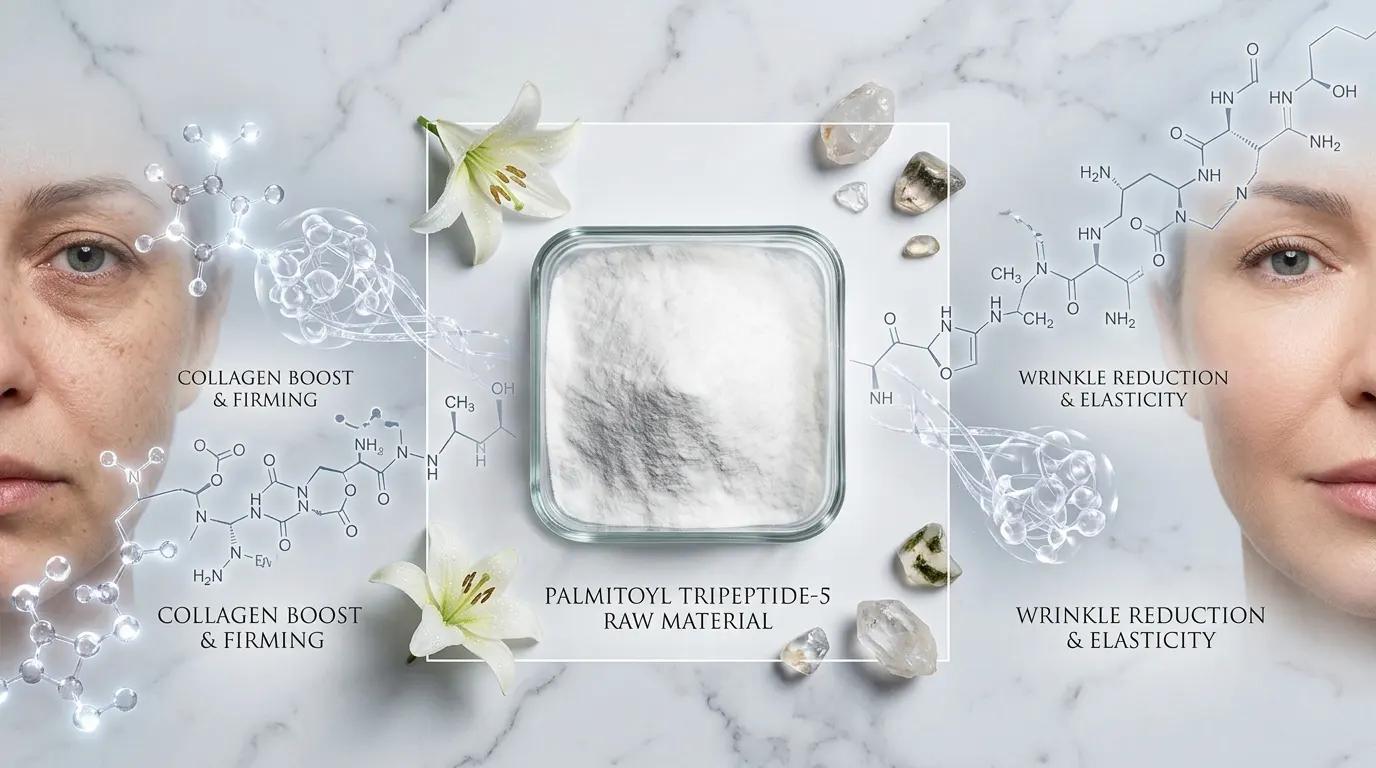
Palmitoyl Tripeptide-5
Functions / Benefits
Quality Specifications
| Specification Item | Standard |
|---|---|
| Grade | Cosmetic Grade |
| Recommended Usage | 0.001%–0.005% (w/w) in finished formulation |
| Property 1 | 98% |
Description
Is Palmitoyl Tripeptide-5 (SYN-COLL) Effective for Anti-Aging? Benefits, Mechanism & Comparison Guide Explained
Yes, Palmitoyl Tripeptide-5 — commercially known as SYN-COLL — is a clinically studied cosmetic peptide with a unique TGF-β-activating mechanism that stimulates collagen types I and III synthesis, inhibits collagen-degrading enzymes (MMP-1 and MMP-3), and has been reported to reduce wrinkle depth by approximately 3.5-fold compared to placebo in surface topography studies.
What Is Palmitoyl Tripeptide-5?
Palmitoyl Tripeptide-5 (CAS 623172-56-5) is a synthetic lipopeptide composed of three amino acids — lysine (K), valine (V), and lysine (K) — conjugated to a palmitoyl (C16 fatty acid) chain. It is commercially known as SYN-COLL or Syn®-Coll, a patented peptide developed by DSM-Firmenich (formerly Pentapharm). Its molecular formula is C₂₈H₅₅N₅O₅ with a molecular weight of approximately 540.76 g/mol.
The palmitoyl moiety enhances skin penetration through the stratum corneum, delivering the active Lys-Val-Lys (KVK) sequence to dermal fibroblasts. The KVK sequence is structurally analogous to the Lys-Arg-Phe-Lys core sequence of thrombospondin-1 (TSP-1) — a key extracellular matrix protein responsible for activating latent transforming growth factor-β (TGF-β). This TSP-1-mimicking mechanism is what distinguishes Palmitoyl Tripeptide-5 from other cosmetic peptides and gives it a uniquely potent collagen-stimulating pathway.
Palmitoyl Tripeptide-5 is available as a white to off-white powder with ≥95% purity (HPLC), water-soluble, and stable across a pH range of 4.0–7.5.
Key Benefits of Palmitoyl Tripeptide-5
TGF-β Activation: A Uniquely Potent Collagen Pathway. Unlike most cosmetic peptides that mimic collagen fragments (matrikines), Palmitoyl Tripeptide-5 works by mimicking thrombospondin-1 (TSP-1) to activate latent TGF-β — a master growth factor that regulates collagen production at the gene expression level. TGF-β activation by Pal-KVK causes a sustained increase in type I and type III collagen mRNA in normal dermal fibroblasts, as well as upregulation of fibronectin. This upstream growth factor mechanism produces a more durable and pronounced collagen-stimulating effect than direct matrikine signaling alone.
Dual Action: Collagen Synthesis + Collagen Protection. Palmitoyl Tripeptide-5 is one of the few cosmetic peptides with a documented dual mechanism: it simultaneously stimulates new collagen production (via TGF-β) and inhibits collagen degradation (via MMP-1 and MMP-3 inhibition). MMP-1 is the primary enzyme responsible for degrading type I collagen; MMP-3 degrades a broad range of ECM proteins including collagen types II and III, fibronectin, and elastin. By blocking both synthesis decline and degradation acceleration, Pal-KVK addresses the two root causes of age-related collagen loss.
Clinically Proven Wrinkle Reduction. An 84-day clinical study using PRIMOS surface topography demonstrated that twice-daily application of Palmitoyl Tripeptide-5 produced a 12% reduction in wrinkle parameters compared to control groups, with an approximately 3.5-fold greater reduction in wrinkle appearance versus placebo. A separate clinical study (Trookman et al., 2009, J Clin Aesthet Dermatol) confirmed immediate and long-term improvements in facial lines and wrinkles with Syn-Coll-containing formulations.
Superior Collagen Stimulation vs. Palmitoyl Pentapeptide-4. Research published in Clinics in Plastic Surgery (Bucay & Day, 2013) reported that Palmitoyl Tripeptide-5 increases collagen type I production via TGF-β activation approximately 60% more effectively than Palmitoyl Pentapeptide-4 (Matrixyl) in comparative in vitro studies — a significant differentiation for formulators seeking maximum collagen-stimulating efficacy.
Skin Hydration and Barrier Support. Beyond collagen, Palmitoyl Tripeptide-5 supports the skin’s barrier function, reduces transepidermal water loss (TEWL), and acts as a humectant to improve moisture retention. It also augments skin surface lipids and provides emollient properties, contributing to a smoother, more supple skin texture.
Depigmentation Potential (Modified Variant). A modified version of Palmitoyl Tripeptide-5 with an L-ascorbate moiety at the C-terminus (Pal-KVK-AA) has been shown to inhibit melanin synthesis and reduce hyperpigmentation caused by photoaging, UV exposure, and oxidative stress — expanding the ingredient’s potential into brightening and anti-spot formulations.
Palmitoyl Tripeptide-5 (SYN-COLL) vs. Palmitoyl Tripeptide-1 (Pal-GHK) vs. Palmitoyl Pentapeptide-4 (Matrixyl): Which Is Best?
These three palmitoyl peptides are the most widely used collagen-stimulating peptides in prestige anti-aging skincare. They share a common goal but differ fundamentally in mechanism, collagen targets, and clinical evidence.
Palmitoyl Tripeptide-5 (SYN-COLL, CAS 623172-56-5) is a tripeptide (Pal-KVK), mimics TSP-1 to activate TGF-β (upstream growth factor pathway), stimulates collagen types I and III + fibronectin, also inhibits MMP-1 and MMP-3 (dual action), is used at 0.001%–0.005% w/w, and is best suited for maximum collagen stimulation, wrinkle reduction, and formulations requiring both synthesis and protection. It is the most potent single collagen-stimulating peptide by mechanism.
Palmitoyl Tripeptide-1 (Pal-GHK, CAS 147732-56-7) is a tripeptide (Pal-GHK), mimics collagen fragments (matrikine pathway), stimulates collagen types I and III + GAGs, is the collagen-signaling component of Matrixyl 3000 (paired with Palmitoyl Tetrapeptide-7), is used at 0.001%–0.01% w/w, and is best suited for collagen rebuilding, hydration support, and Matrixyl 3000-style multi-peptide complexes. It is the preferred choice for comprehensive complex formulations.
Palmitoyl Pentapeptide-4 (Matrixyl, CAS 214047-00-4) is a pentapeptide (Pal-KTTKS), mimics procollagen type I fragments (matrikine pathway), stimulates collagen types I and IV + fibronectin, has the most extensive standalone clinical evidence base of any cosmetic peptide, is used at 0.001%–0.01% w/w, and is best suited for targeted collagen stimulation, wrinkle reduction, and wound healing support. It is the gold standard for standalone clinical evidence.
Bottom line: Palmitoyl Tripeptide-5 offers the most potent collagen-stimulating mechanism through TGF-β activation and adds MMP inhibition for dual protection. Palmitoyl Pentapeptide-4 has the strongest standalone clinical track record. Palmitoyl Tripeptide-1 is the preferred choice for Matrixyl 3000-style complexes. For maximum anti-aging efficacy, premium formulations increasingly combine all three peptides to cover every pathway: TGF-β activation, matrikine signaling, MMP inhibition, and anti-inflammatory coverage.
Formulation and Usage Recommendations
Palmitoyl Tripeptide-5 is effective at very low concentrations: 0.001%–0.005% w/w in finished formulations. It is water-soluble and should be added to the aqueous phase during formulation at temperatures below 40°C to preserve peptide integrity. Optimal pH range is 4.0–7.5.
It is compatible with most cosmetic actives including retinol, niacinamide, vitamin C (at appropriate pH), hyaluronic acid, and other peptides. It combines synergistically with Palmitoyl Pentapeptide-4 (for complementary matrikine collagen signaling), Palmitoyl Tripeptide-1 + Palmitoyl Tetrapeptide-7 (Matrixyl 3000, for anti-inflammatory coverage), GHK-Cu (for copper-mediated collagen remodeling), and Acetyl Hexapeptide-3 / SNAP-8 (for expression line reduction).
Typical finished product applications include high-performance anti-aging serums, eye creams, night creams, firming moisturizers, and multi-peptide complex formulations targeting maximum collagen density.
Safety and Precautions
Palmitoyl Tripeptide-5 has an excellent safety profile and is approved for use in cosmetic formulations globally, including under EU Cosmetics Regulation and FDA cosmetic guidelines. It is non-toxic, non-mutagenic, and non-sensitizing at recommended use levels. No significant adverse reactions have been reported in clinical studies at standard cosmetic use concentrations.
This ingredient is intended for use in topical cosmetic formulations only and is not for oral consumption. Formulators should conduct standard patch testing and stability assessments for finished products. Always consult with a qualified cosmetic chemist or dermatologist before incorporating new actives into clinical or consumer formulations. These statements have not been evaluated by the Food and Drug Administration. This product is not intended to diagnose, treat, cure, or prevent any disease.