Spermidine
Functions / Benefits
Quality Specifications
| Specification Item | Standard |
|---|---|
| Grade | Pharmaceutical Grade |
| Recommended Usage | 1–5 mg/day |
| Property 1 | 98% |
Description
Is Spermidine Good for Longevity and Healthy Aging? Benefits, Dosage & Side Effects Explained
Yes, spermidine is one of the most compelling natural compounds in longevity research, with strong preclinical and growing clinical evidence supporting its role in autophagy induction, cardiovascular health, cognitive function, and extended healthspan. At doses of 1–5 mg/day, it is safe and well tolerated, with a wide margin of safety established in toxicology studies.
What Is Spermidine?
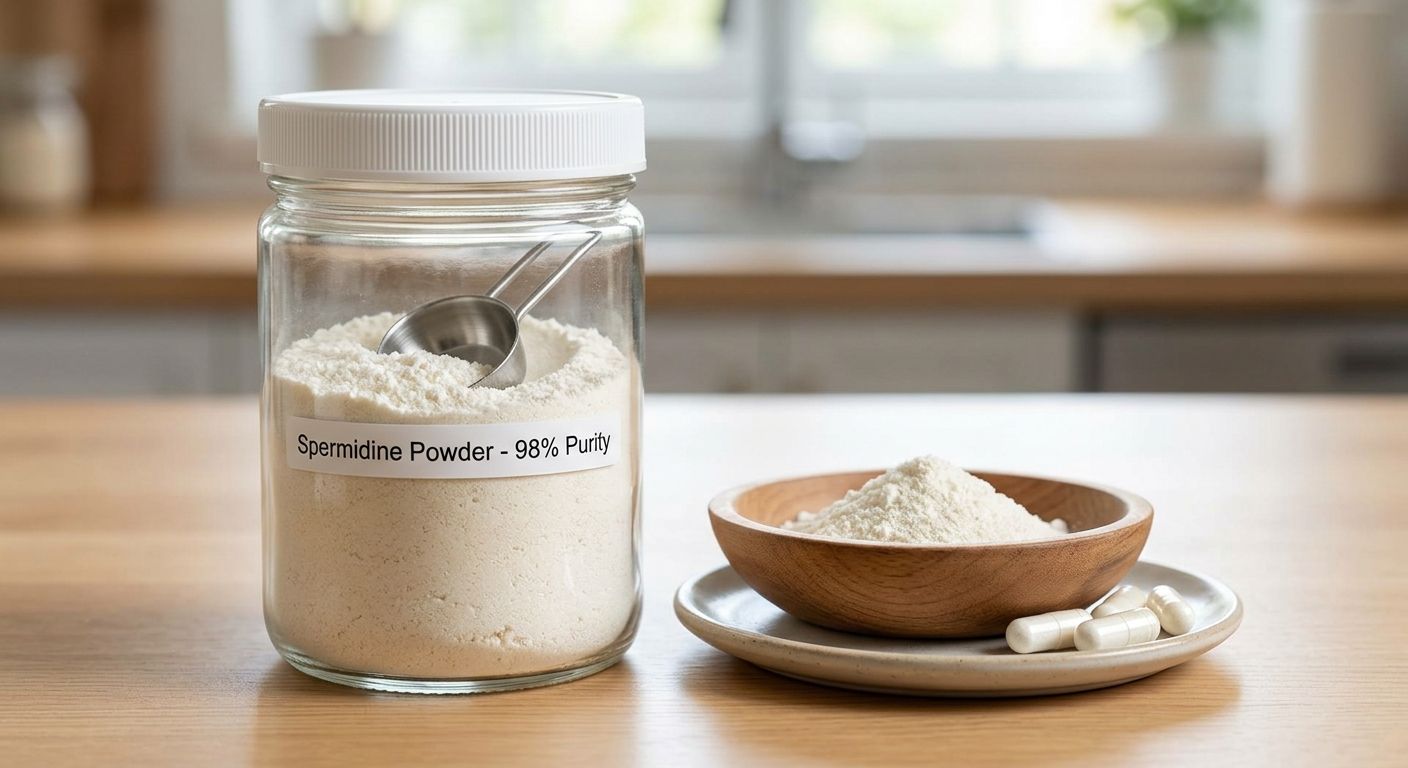
Spermidine (CAS 124-20-9) is a naturally occurring polyamine with the molecular formula C₇H₁₉N₃ and a molecular weight of 145.25 g/mol. It belongs to the polyamine family alongside putrescine and spermine, and is found in virtually every living cell. In the human body, spermidine is produced endogenously, synthesized by gut bacteria, and obtained through diet.
The richest dietary sources of spermidine include wheat germ (up to 243 mg/kg), soybeans and natto, mushrooms, aged cheeses, legumes, and shellfish. However, spermidine content in food varies dramatically depending on variety, growing conditions, and processing — refined wheat products, for example, contain only trace amounts compared to wheat germ. Average dietary intake is approximately 10 mg/day, but endogenous production declines significantly with age, making supplementation increasingly relevant for older adults.
Commercially, spermidine is available as the free base (CAS 124-20-9) or as spermidine trihydrochloride, produced via chemical synthesis or extraction from wheat germ, with pharmaceutical-grade purity of ≥98%.
Key Benefits of Spermidine
Autophagy Induction: The Core Longevity Mechanism. Spermidine is one of the most potent natural inducers of autophagy — the body’s cellular recycling system that clears damaged proteins, dysfunctional organelles, and cellular debris. A landmark 2024 Nature Cell Biology study confirmed that spermidine is essential for fasting-mediated autophagy, establishing it as a critical mediator of one of the most powerful longevity pathways known. Spermidine activates autophagy by inhibiting acetyltransferases (EP300), modulating histone acetylation, and activating TFEB — the master regulator of lysosomal biogenesis.
Cardiovascular Health and Mortality Reduction. The Bruneck Study, a major prospective cohort study following 829 participants aged 45–84 over 15 years, found that individuals with higher dietary spermidine intake had approximately 40% reduced risk of fatal heart failure, lower blood pressure, reduced cardiovascular disease events, and lower all-cause mortality. These are among the most compelling human data linking any dietary compound to longevity outcomes.
Cognitive Function and Neuroprotection. Clinical trials using approximately 3.3 mg of spermidine per day (via wheat germ-based supplementation) showed improvements in cognitive performance in older adults with mild cognitive impairment. Spermidine supports neuronal autophagy, reduces amyloid-beta accumulation, and protects against age-related neurodegeneration. Animal studies show spermidine supplementation extended median lifespan by 10–15% even when started late in life.
Anti-inflammatory and Immune Modulation. A year-long human dietary intervention with a polyamine-rich diet increased blood spermine levels and significantly reduced pro-inflammatory markers. Spermidine modulates T-cell function, supports immune aging (immunosenescence), and has been shown to enhance vaccine responses in older adults.
Hair Growth and Skin Health. Spermidine promotes hair follicle cycling and has been studied in clinical trials for hair growth support. It also accelerates wound healing and supports skin barrier integrity through its role in cellular renewal and autophagy.
Mitochondrial Support. Spermidine supports mitochondrial function and biogenesis, protecting against age-related mitochondrial dysfunction through its autophagy-activating and anti-inflammatory mechanisms.
Spermidine vs. Spermine vs. Putrescine: Which Polyamine Is Best?
Spermidine belongs to the polyamine family, which also includes spermine and putrescine. All three are naturally occurring, interconvertible, and essential for cell growth and function, but they differ in structure, potency, and research support.
Spermidine (CAS 124-20-9) is a triamine with the strongest autophagy-inducing activity of the three, the most extensively studied polyamine for longevity and healthspan, found in high concentrations in wheat germ, soybeans, and mushrooms, used at 1–5 mg/day, and best suited for anti-aging, cardiovascular health, cognitive support, and autophagy activation. It is the leading polyamine supplement.
Spermine (CAS 71-44-3) is a tetramine (longer chain), a downstream metabolite of spermidine, has potent anti-inflammatory and cardioprotective properties, is found in high concentrations in animal products (meat, fish), and is less studied as a standalone supplement. It is best suited for cardiovascular and immune applications, often elevated by spermidine supplementation.
Putrescine (CAS 110-60-1) is a diamine (shorter chain), a precursor to spermidine in the biosynthetic pathway, has lower potency for autophagy induction, is found in fermented foods and aged cheeses, and is less studied for longevity. It is best suited as a marker of polyamine metabolism rather than a primary supplement target.
Bottom line: spermidine is the most researched and most potent polyamine for longevity supplementation. Spermine levels are naturally elevated when spermidine intake increases, making spermidine supplementation effectively a two-for-one approach. Putrescine is primarily relevant as a dietary precursor rather than a direct supplement target.
Dosage and Usage Recommendations
Spermidine is effective at very low doses compared to most longevity supplements. Clinically studied doses range from 1 to 5 mg/day of pure spermidine (equivalent to approximately 1–1.5 g/day of high-quality wheat germ extract standardized to 1% spermidine). It can be taken at any time of day, with or without food. Some users prefer taking it in the evening to align with overnight autophagy and cellular repair processes.
Spermidine combines synergistically with fisetin and quercetin (for senolytic activity), NMN or NR (for NAD+ and energy metabolism), and PQQ and CoQ10 (for mitochondrial support) as part of a comprehensive longevity stack.
Safety and Precautions
Spermidine has an excellent safety profile. Toxicology studies in animals show no adverse effects at doses far exceeding typical human intake, and it is not genotoxic in standard testing. No deficiency state has been identified, as the body produces it endogenously. Caution is advised in individuals with active cancer, as the role of polyamines in tumor biology is complex and not fully resolved. Always consult with a qualified healthcare provider before starting spermidine supplementation, especially if you have a history of cancer, are pregnant or nursing, or are managing a chronic health condition. This product is intended for use by healthy adults and is not a substitute for medical treatment. These statements have not been evaluated by the Food and Drug Administration. This product is not intended to diagnose, treat, cure, or prevent any disease.
Featured Products
Fisetin
Rhus succedanea / Cotinus coggygria (Smoke Tree)
Quercetin
Sophora japonica / Allium cepa