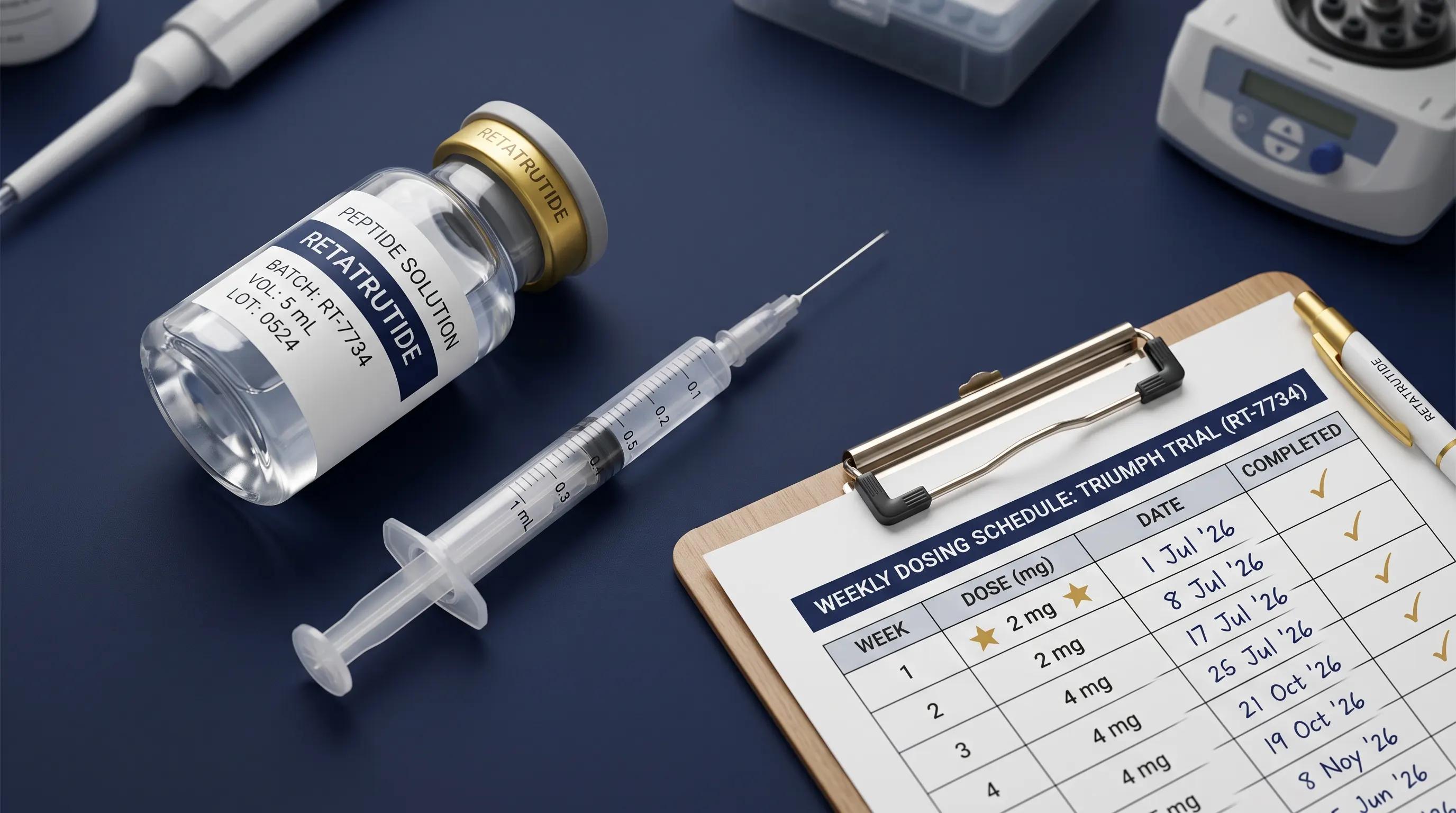
Retatrutide Dosage Guide: Clinical Dosing Protocols & Research Reference
Table of Contents
Retatrutide Clinical Dosing Overview
Retatrutide (LY3437943) represents the first investigational triple receptor agonist to concurrently target GLP-1, GIP, and glucagon receptors. Understanding the dosing protocols evaluated in clinical trials is essential for researchers investigating this novel peptide. This guide summarizes the dosing schedules and titration protocols from published Phase 2 clinical data.
Important: The following dosing information is derived from published clinical trial protocols and is provided strictly as a research reference. These doses represent regimens evaluated in controlled clinical settings and are NOT intended as guidance for any human application.
Phase 2 Trial Dosing Protocol
The Phase 2 randomized, double-blind, placebo-controlled trial (Jastreboff et al., New England Journal of Medicine, 2023) evaluated retatrutide across multiple dose groups. Participants were randomized to receive once-weekly subcutaneous injections at doses escalating to 1 mg, 4 mg, 8 mg, or 12 mg.
Dose Escalation Schedule
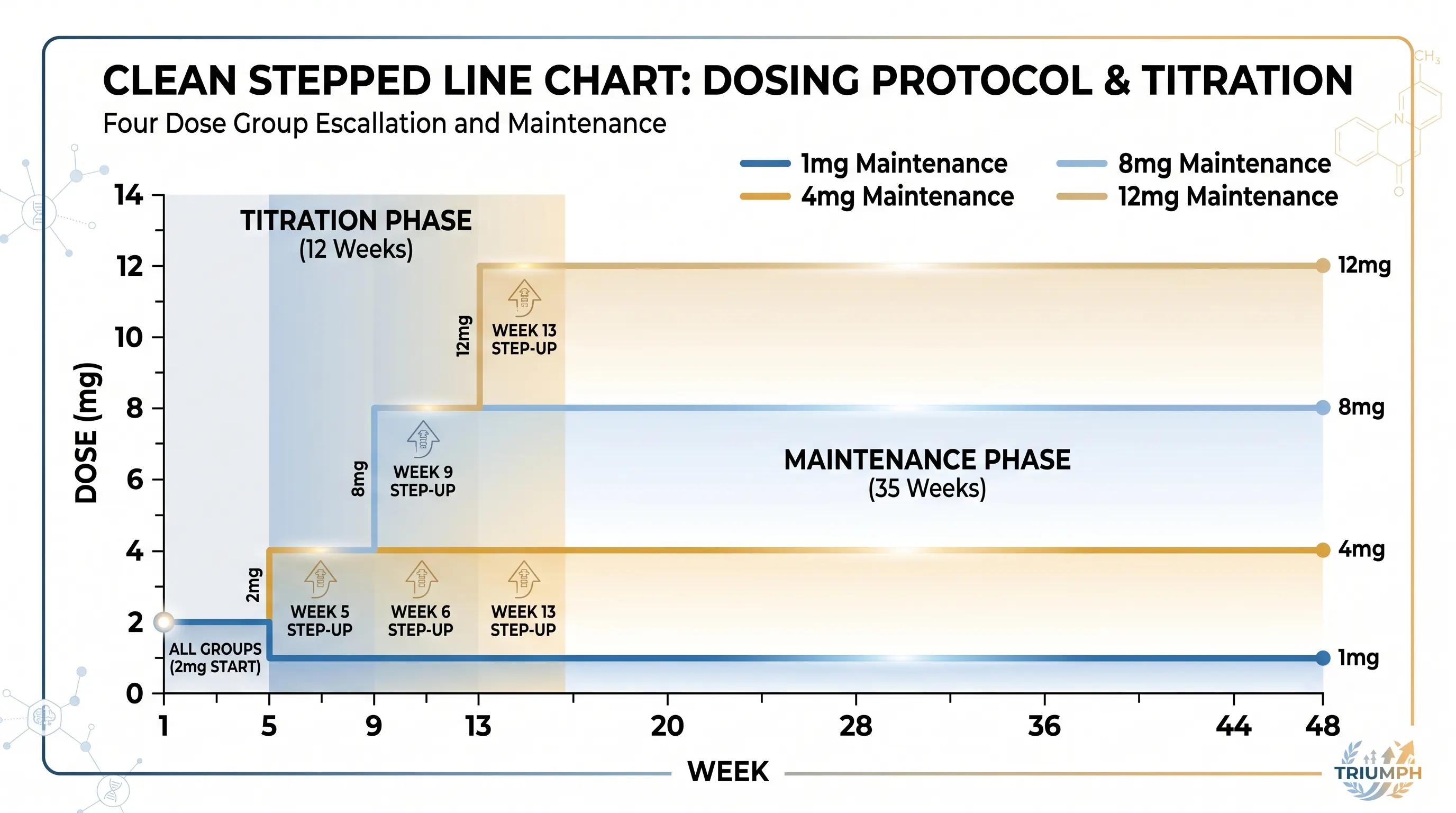
All participants started at a low dose and escalated over a 24-week titration period to improve tolerability and minimize gastrointestinal adverse events:
Starting Dose: 2 mg once weekly (all groups)
Week 5-8: Increase to 4 mg once weekly
Week 9-12: For 8 mg and 12 mg groups, increase to 8 mg once weekly
Week 13-24: For the 12 mg group only, step up to 12 mg once weekly
The 1 mg and 4 mg groups remained at their target doses through weeks 24-48. The 8 mg and 12 mg groups completed titration by weeks 12 and 24, respectively, and then continued at their maintenance doses for the remainder of the 48-week study.
Concentration & Reconstitution Reference
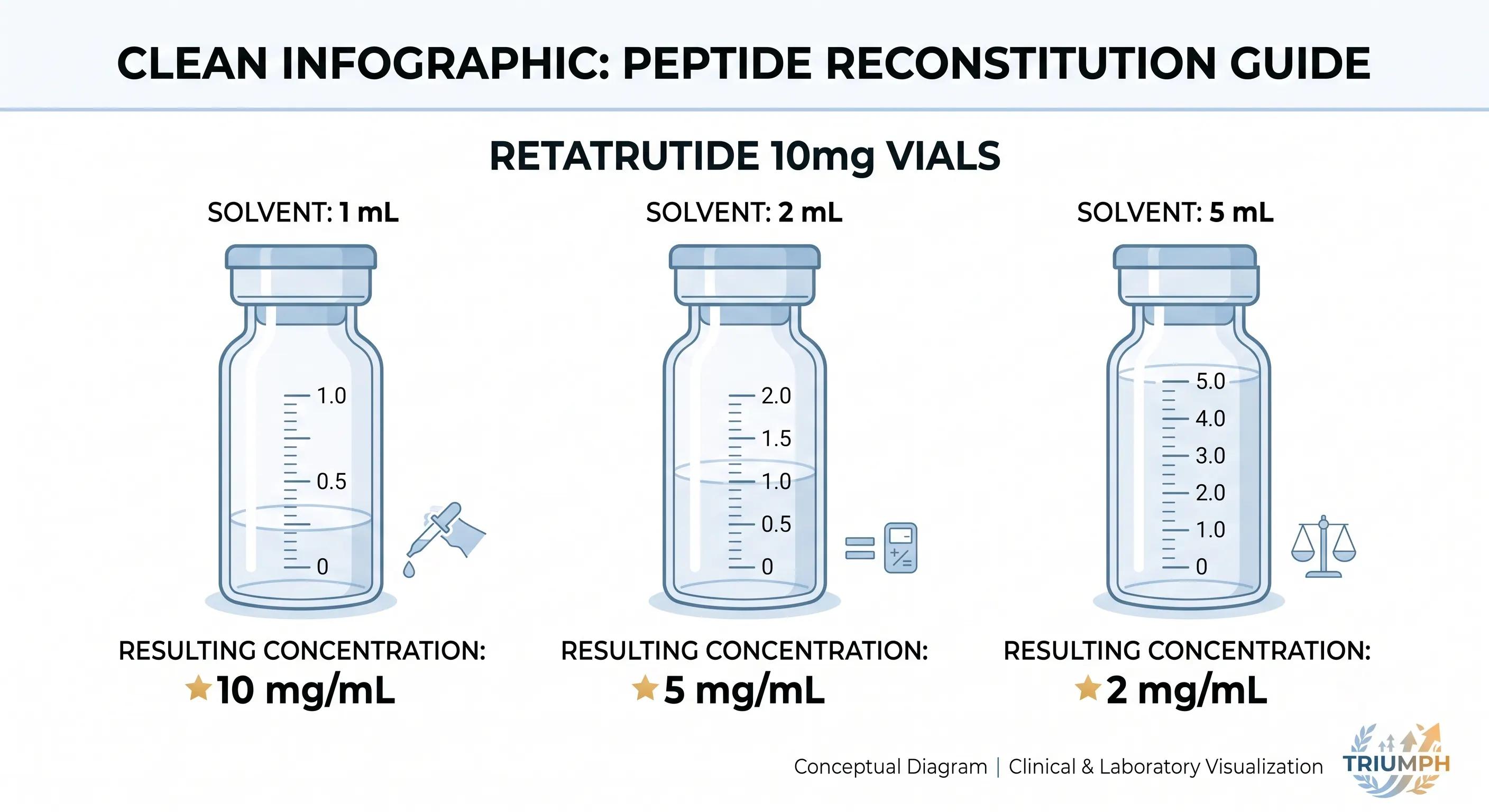
For researchers conducting reconstitution experiments, the following reference table provides common concentration calculations based on vial size and solvent volume:
10 mg vial + 1 mL bacteriostatic water: 10 mg/mL concentration
10 mg vial + 2 mL bacteriostatic water: 5 mg/mL concentration
10 mg vial + 5 mL bacteriostatic water: 2 mg/mL concentration
At 2 mg/mL, a 0.1 mL draw yields 0.2 mg; 1.0 mL yields 2 mg. Researchers should select solvent volumes according to their specific experimental protocol requirements. For detailed reconstitution instructions, see our How to Reconstitute Retatrutide guide.
Weekly Administration Protocol (Clinical Setting)
In the Phase 2 trial, retatrutide was administered as a once-weekly subcutaneous injection. The weekly dosing schedule was selected to balance sustained receptor engagement with practical administration frequency. Key protocol details include:
Administration route: Subcutaneous injection (abdomen, thigh, or upper arm)
Frequency: Once weekly, same day each week
Timing: Can be administered at any time of day, with or without food
Missed dose protocol: If a dose is missed and the next scheduled dose is more than 3 days away, administer as soon as possible. If less than 3 days remain, skip the missed dose and resume the regular schedule.
Dose-Response Relationship
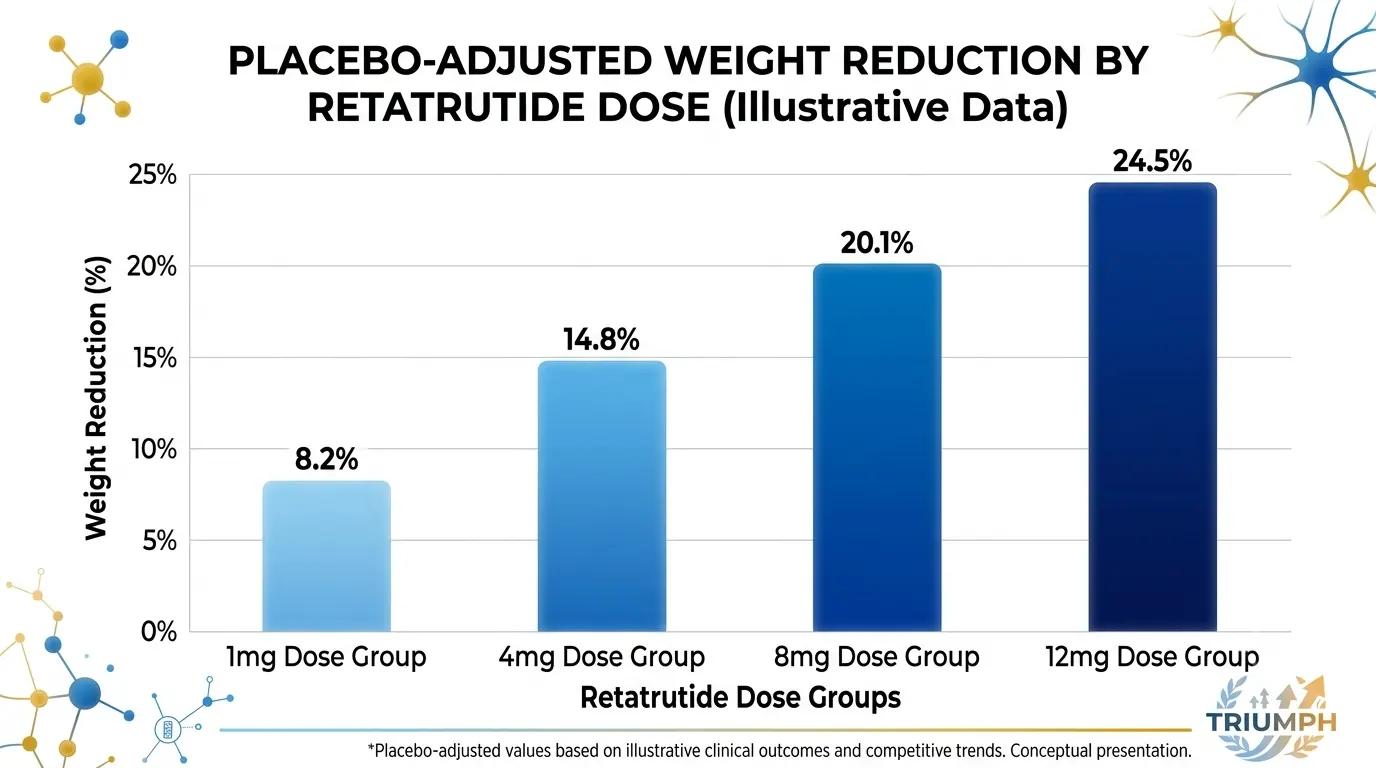
The Phase 2 data demonstrated a clear dose-response relationship for body weight reduction. At 48 weeks, mean placebo-adjusted weight reduction was approximately:
1 mg group: -7%
4 mg group: -12%
8 mg group: -17%
12 mg group: -22%
Gastrointestinal adverse events showed a dose-dependent pattern, with nausea rates increasing from approximately 16% in the 1 mg group to 45% in the 12 mg group. The gradual dose-escalation protocol was employed to mitigate these effects, particularly at higher doses.
Research Considerations for Dosing Studies
Investigators designing preclinical or in vitro experiments involving retatrutide should consider the following:
Peptide stability: Retatrutide in solution should be used within 28 days when stored at 2-8C. Avoid repeated freeze-thaw cycles.
Sterility: Use aseptic technique during reconstitution. Bacteriostatic water is recommended for multi-use vials in research settings.
Concentration verification: When preparing specific concentrations for experimental use, verify calculations against the peptide content stated on the Certificate of Analysis, accounting for peptide content percentage (net peptide weight vs. gross weight).
Batch consistency: For longitudinal studies, consider sourcing from a single production batch to minimize inter-batch variability.
Key Takeaways
The retatrutide Phase 2 clinical trial employed a weekly subcutaneous dosing regimen with doses escalating from 2 mg to target maintenance doses of 1 mg, 4 mg, 8 mg, or 12 mg. The gradual titration protocol over 24 weeks was designed to optimize tolerability. Researchers should note that these data are from a single Phase 2 trial; Phase 3 data from the ongoing TRIUMPH program may refine the dosing understanding.
For research-grade retatrutide peptide for your laboratory investigations, refer to the COSPEP Retatrutide product page.
Frequently Asked Questions
What is the recommended retatrutide dosage in clinical trials?
In the Phase 2 trial, retatrutide was administered at 1 mg, 4 mg, 8 mg, or 12 mg once weekly via subcutaneous injection, following a gradual dose-escalation protocol starting from 2 mg.
How often is retatrutide administered in clinical studies?
Retatrutide is administered once weekly, on the same day each week, as established in the Phase 2 clinical trial protocol by Eli Lilly.
What is the starting dose of retatrutide in clinical research?
All dose groups in the Phase 2 trial started at 2 mg once weekly. Dose escalation to higher target levels occurred at 4-week intervals over a 24-week titration period.
How is retatrutide reconstituted for research use?
Retatrutide lyophilized powder is reconstituted using bacteriostatic water or sterile water for injection. For a 10 mg vial, adding 1 mL yields 10 mg/mL; adding 2 mL yields 5 mg/mL. Always use aseptic technique.
What is the retatrutide dosing schedule from the clinical trials?
The Phase 2 escalating schedule was: 2 mg (weeks 1-4), 4 mg (weeks 5-8), 8 mg (weeks 9-12), with the 12 mg group increasing to 12 mg for weeks 13-48. The 4 mg and 8 mg groups remained at their target doses from weeks 12 to 48.
Need Bulk Peptide Raw Materials?
COSPEP Biotech is a GMP-compliant China peptide supplier providing worldwide shipping and custom formulations.